Selecting the proper backend development company might be critical for your project.
Although most end users won’t ever see your backend, they will rely on it each time they enter your application, make a transaction, request some page, or take advantage of any other functionality.
The well-developed backend provides you with fast performance, high security, and scalability for your software. Otherwise, you’ll have to deal with slow performance, lack of security, downtime and costly maintenance.
Unfortunately, hundreds of backend development companies claim to provide you with all these advantages. How can you find the right one?
This is what we’ve created this guide for.
Our research covers the top backend development companies with respect to their technological skills, user feedback, industry experience, technology stack, and scalability capabilities.
In this guide, you'll explore:
- Top 25 backend development companies
- Their services, strengths, and technology expertise
- How much does backend development cost
- How to compare companies and avoid common hiring mistakes
- How to choose the right backend partner for your project
By the end, you'll have a clear shortlist of companies and know exactly what to look for before making your decision.
What Is a Backend Development Company?
The backend development company is the one that creates server-side solutions for websites, mobile applications and software.
This company builds APIs, databases, business logic and cloud infrastructure in order to provide proper functioning, safety and scalability of the application as your company expands.
In other words, the backend performs all the work in the background when the user works with the frontend.
Top 25 Backend Development Companies
Here is a quick comparison of all 25 backend development companies before we go deeper into each one.
| Company | Best For | Core Stack | Location |
|---|---|---|---|
| Ciphernutz IT Services | Fixed-scope, production-ready backends | Node.js, Python, NestJS, microservices | India (US, UK, Middle East) |
| Soft Suave | Low-risk offshore onboarding | Node.js, Java, Python, Laravel | India |
| MindInventory | AI and cloud-integrated backends | Node.js, Python, AWS | India |
| Simform | Azure-heavy enterprise builds | .NET, Node.js, Azure | USA |
| Brainvire | eCommerce and CMS backends | PHP, .NET, Node.js, Laravel | USA, India |
| Kellton | Enterprise modernization | Java, .NET, Node.js, Python | USA, India |
| CMARIX | Integration-first custom logic | Node.js, PHP, .NET | India |
| Chetu | Deep vertical software | Python, Java, .NET, Node.js | USA |
| Aalpha Information Systems | Cost-efficient global delivery | PHP, Node.js, Python | India |
| Radixweb | Enterprise SaaS and cloud | .NET, Node.js, Django, Laravel | India |
| Devox Software | Real-time and regulated apps | Node.js, Python, Java | Poland |
| Digiteum | Data-centric backends | Python, Node.js, AWS | Belarus, USA |
| Bigscal Technologies | Flexible, cost-controlled teams | .NET, PHP, Java, Node.js | India |
| Infinum | Product-grade engineering | Node.js, Python, Java | Europe, USA |
| AgileEngine | Agile, integration-heavy builds | Python, Node.js, Java | USA |
| Softeq | IoT plus backend systems | Python, Node.js, C++ | USA |
| SunTec India | Backend audits and tuning | .NET, Django, Node.js, PHP | India |
| HashStudioz Technologies | Polyglot and cloud-native | Node.js, Django, Spring Boot, Go | India, USA |
| OptiSol Business Solutions | API and data engineering | Node.js, .NET, Java, Python | Australia, India |
| Konstant Infosolutions | App-focused backends | PHP, Python, Node.js | India |
| Sapphire Software Solutions | Microservices and multi-cloud | Node.js, Python, PHP, Ruby | India |
| Netguru | Backend consulting for scale-ups | Ruby on Rails, Node.js, Python | Poland |
| STX Next | Python and data-heavy apps | Python, Django, ML tooling | Poland |
| Thoughtbot | Code quality and Rails | Ruby on Rails, Elixir | USA |
| Toptal | On-demand senior specialists | Node.js, Python, Java | Remote |
Let’s explore each company in detail!
1. Ciphernutz IT Services
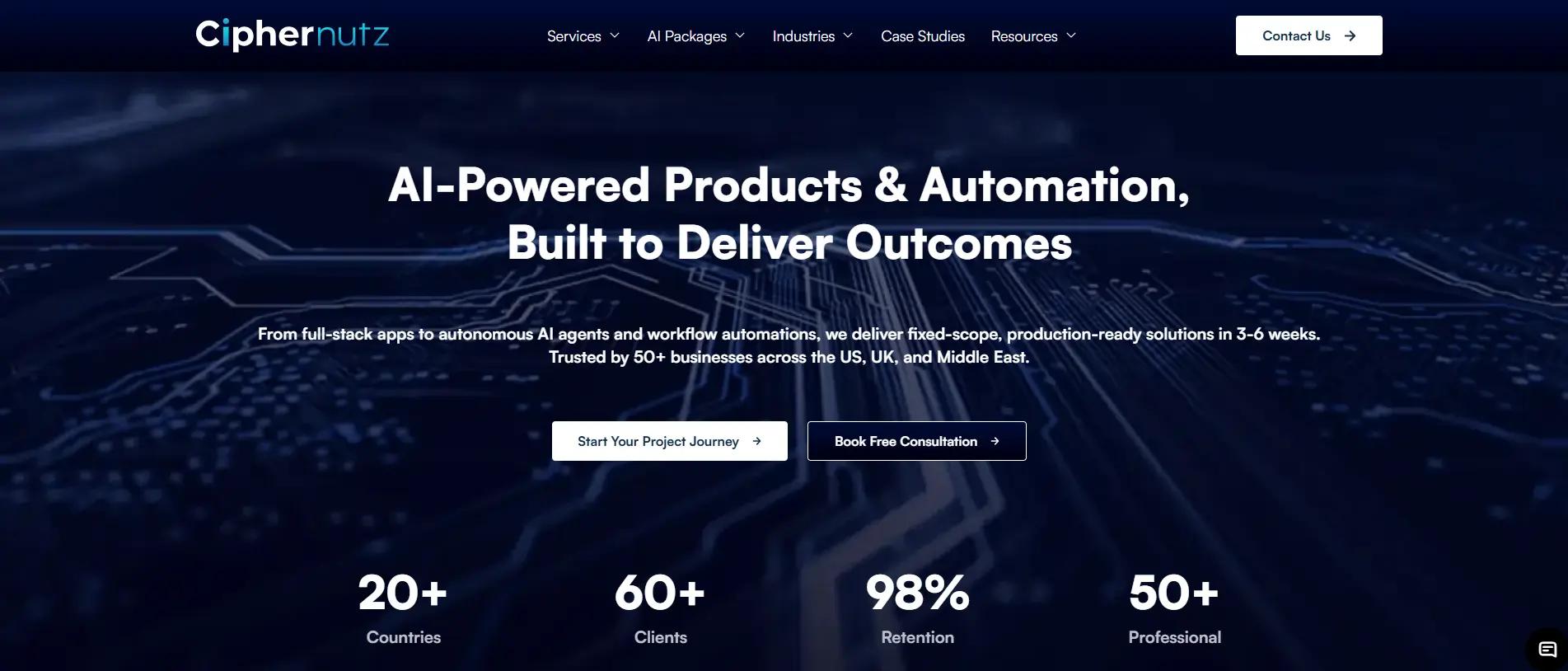
Ciphernutz is an AI-driven product engineering agency that views your backend as engineering for the long term, not disposable code. They deliver reliable, secure, and high-performing APIs, microservices, and distributed systems engineered for scalability with your business.
The experience of 7+ years of delivery, 60+ clients in 20+ countries, and a 98% client retention rate gives a strong edge. The team combines senior-level backend expertise with fixed-scope projects in 3 to 6 weeks. You also get a dedicated project manager, a one-week risk-free trial, and no template-based approach.
For startups and products looking for a reliable backend development partner, Ciphernutz is the best option among these services.
Key Highlights:
- 60+ clients across 20+ countries, and a 98% client retention rate that proves consistent delivery.
- Production-ready backends in 3 to 6 weeks with fixed-scope pricing, so timelines and costs stay predictable.
- Senior engineering depth in secure APIs, microservices, and cloud-ready architecture using Node.js, Python, and NestJS.
- Zero templates and compliance built in, with every system architected around your stack and HIPAA-ready from day one.
- A one-week risk-free trial plus a dedicated project manager, so you start with zero downside.
Best for: Fixed-scope, production-ready backends for SaaS, healthcare, and growing products
2. Soft Suave
Soft Suave is the offshore partner that has gained popularity due to its efficiency and safety in assembling teams. You can select developers in two days and test them during the trial period. A diverse technology stack and the well-defined approach of this partner can be seen as an option for startups that want high-quality work with minimal initial risks.
Best for: Low-risk offshore onboarding
3. MindInventory
MindInventory blends backend engineering with AI, machine learning, and cloud-native design. They build scalable server-side systems for web and mobile products, often helping startups move from a rough MVP to a robust architecture. Their strength is connecting clean backend logic with smarter, data-driven features.
Best for: AI and cloud-integrated backends
4. Simform
Simform brings deep cloud expertise and a large team of certified engineers. They design backends for ERP and CRM environments and use in-house accelerators to speed up delivery. For products built on Azure or needing strong governance, they offer serious technical depth.
Best for: Azure-heavy enterprise builds
5. Brainvire
Brainvire focuses on backends that power online stores and content-heavy platforms. They handle APIs, database management, and secure integrations across eCommerce and enterprise systems. Their experience with migrations and CMS work makes them a fit for retail-driven products.
Best for: eCommerce and CMS backends
6. Kellton
Kellton’s expertise lies in converting legacy systems into state-of-the-art backends. They provide solutions in several programming languages and couple their backend services with cloud and DevOps services. Their approach to digital transformation is quite suitable for enterprises that require modernization without disruption of their operations.
Best for: Enterprise modernization
7. CMARIX
CMARIX provides custom backend solutions that excel in incorporating business logic and integration into your application. They integrate your systems with CRMs, ERPs, and third-party APIs required for your workflows. In case you are looking for one vendor for backend and related frontend services, they can be a good choice.
Best for: Integration-first custom logic
8. Chetu
Chetu is known for industry-specific software backed by a wide range of languages and databases. Their teams handle complex business logic and increasingly weave in AI features for automation. For niche or heavily regulated domains, their domain depth is a real advantage.
Best for: Deep vertical software
9. Aalpha Information Systems
Aalpha provides versatile and cost-effective backend solutions across industries. They provide backend development services, APIs, automation services, NLP solutions, and even generative AI.
Best for: Cost-efficient global delivery
10. Radixweb
Radixweb treats the backend as a part of a larger system as opposed to an isolated layer. They develop cloud and SaaS platforms with efficient DevOps and security practices mainly in healthcare, fintech, and manufacturing domains. Moreover, they join failing projects to revive them.
Best for: Enterprise SaaS and cloud
11. Devox Software
Devox develops backends for fintech, logistics, and eCommerce platforms and mainly uses real-time capabilities. Reliability and security become their priorities in developing transactional or live-tracking platforms because of their awareness of the industry requirements.
Best for: Real-time and regulated apps
12. Digiteum
Digiteum focuses on how data flows through your systems and how it will be used later. They favor long-term partnerships where the backend evolves alongside the product. Their priority on code quality and maintainability suits data-heavy platforms built to last.
Best for: Data-centric backends
13. Bigscal Technologies
Bigscal becomes an ideal partner for startups and mid-size companies that require flexibility in engagement levels. It is possible to adjust the team size according to the present needs. They optimize APIs and databases to keep your product highly responsive under growing load.
Best for: Flexible, cost-controlled teams
14. Infinum
They design backends that perfectly fit your product roadmap. The approach to software development includes clean architecture, code reviews, and testing to minimize bugs and debt. For products that have to grow steadily and without any risk of instability, they can be trusted.
Best for: Product-grade engineering
15. AgileEngine
AgileEngine pairs speed with quality through cross-functional, iterative teams. They handle modern architectures, microservices, and integration with existing enterprise systems. Their flexible model helps you adjust scope as business priorities shift mid-project.
Best for: Agile, integration-heavy builds
16. Softeq
Softeq stands out for connecting backend systems with devices, sensors, and hardware. If your product involves IoT or special hardware, they can build both sides reliably. Their work often carries strict security requirements for enterprise and regulated use.
Best for: IoT plus backend systems
17. SunTec India
SunTec India builds backends from the ground up and also improves existing ones. They are strong on backend audits, performance tuning, and cloud migration. They treat the backend as an ongoing process, with attention to scaling, testing, and long-term stability.
Best for: Backend audits and tuning
18. HashStudioz Technologies
HashStudioz works across an unusually wide stack and adapts to whatever a system needs. They cover server-side logic, APIs, and data flow, plus cloud migration and reworking older systems. Their use of containerization and CI/CD keeps deployments consistent and reliable.
Best for: Polyglot and cloud-native
19. OptiSol Business Solutions
OptiSol focuses on clean API engineering and reusable, well-structured code. They handle data migration, performance optimization, and security across full-stack projects. Their collaborative approach between backend and frontend teams keeps delivery smooth.
Best for: API and data engineering
20. Konstant Infosolutions
Konstant builds backends that power mobile apps and websites with steady performance. They manage server-side logic, databases, and API integrations with attention to security and connectivity. Their app-first focus suits products where the backend supports rich user interactions.
Best for: App-focused backends
21. Sapphire Software Solutions
Sapphire builds custom backend architectures with microservices and multi-cloud deployments. They handle API development, database management, and real-time functionality across business needs. Their full-cycle model covers everything from initial setup to ongoing support.
Best for: Microservices and multi-cloud
22. Netguru
Netguru helps businesses design scalable database schemas and clear architectural plans. They are a strong fit for startups and scale-ups that need structured backend consulting before building. Their focus on future-ready architecture keeps products from hitting walls as they grow.
Best for: Backend consulting for scale-ups
23. STX Next
STX Next is one of Europe's largest Python houses, with deep machine learning experience. They excel at custom servers for complex web applications and data-driven products. If your project leans heavily on Python or advanced algorithms, they are a top contender.
Best for: Python and data-heavy apps
24. Thoughtbot
Thoughtbot has a strong reputation in the Rails community and a culture built on clean code. They emphasize test-driven development, maintainability, and sustainable practices. Their senior technical leaders offer strategic guidance, not just implementation.
Best for: Code quality and Rails
25. Toptal
The Toptal website is known to connect you with a network of highly qualified freelance backend developers. The best scenario to use Toptal is when you require an expert immediately but don’t want a permanent hire.
Best for: On-demand senior specialists
How to Choose the Right Backend Development Company
These eight factors separate a backend development company or backend development agency that fits from one that creates problems later:
1. Match the tech stack to your project
Look at the technologies a team works with daily versus what your product needs. A stack mismatch creates friction, slower delivery, and weaker decisions. The right fit means they move fast and make smart calls from the start. Ask which stacks they have actually shipped to production, not just tested.
2. Check industry and domain experience
Backend needs vary sharply by industry. Healthcare demands compliance, fintech needs fraud handling, and eCommerce needs payments and inventory logic. A partner who has worked in your space understands these requirements without lengthy explanation. That shared context usually means fewer costly misunderstandings later.
3. Review the portfolio and case studies
Find out projects similar to yours by volume and complexity. The case study shows what problems a team solves and how. Note which difficulties they describe and how they resolve them. Any real success stories count much more than a well-written presentation.
4. Assess communication and workflow
Backend work needs steady collaboration about tradeoffs and timelines. Notice whether a team asks sharp questions about your goals and constraints. Clear, prompt communication often matters as much as raw technical skill. Weak communication early almost always turns into bigger problems later.
5. Evaluate team size and availability
Understand who will actually work on your project and at what seniority. Ask how many people are assigned and whether they have bench strength. You want continuity if a key engineer ever rolls off mid-build. Knowing this upfront protects your timeline from sudden staffing gaps.
6. Confirm security and compliance standards
The team that is worth considering will freely discuss issues of encryption, access control, and incident response. The team is expected to know the standards applicable to your industry. Avoid the teams that treat security matters lightly. Inquire how they solve vulnerability issues and conduct audits and access management.
7. Compare pricing and engagement flexibility
Compare the price per hour to the productivity and expertise level of the team. The team that is cheap but not reliable may cost you much more due to extra work. Search for a flexible pricing model that would allow you to adjust your team size depending on the project stage.
8. Check post-launch support and ownership
Backends outlive most development contracts. Make sure that a vendor has plans for documenting, transferring knowledge, and maintaining systems. You should be able to fully own and control your codebase and backend infrastructure from day one. It will also avoid conflicts later on if you change your vendors.
| Expert Insight: After building backend systems across multiple industries, we've learned that technical expertise alone doesn't determine project success. Teams that prioritize architecture planning, documentation, communication, and post-launch support consistently deliver more scalable products than teams that simply write code faster.
Also Read: 12 Types of Backend Development Services
Questions to Ask Before Hiring a Backend Development Company
These questions can help you find an ideal backend development firm. Below you will see a list of important questions that you need to ask in the first meeting with your potential partner.
1. What is your strategy for dealing with technical solutions?
2. Do you have any approaches to testing and quality assurance?
3. How do you deal with database migrations and schema changes?
4. What do you do in case of production issues?
5. How do you create and maintain documentation?
6. Have you done a project that encountered any problems, and how did your team resolve these issues?
7. Do you have any experience in our industry or something like our project?
8. What tools do you suggest using in our project and why?
9. How do you ensure backend security?
10. What kind of support do you provide after the project is launched?
6 Common Mistakes to Avoid When Hiring a Backend Development Company (With Solutions)
Avoiding these common pitfalls can save you time, money, and unnecessary stress:
Mistake 1: Choosing Based Only on Price
A cheap backend development company doesn't mean the best one. They lack the necessary skills and experience that could be very expensive in the future.
Solution: Don't base your selection process on the price but on the competence, portfolio, customer reviews, etc.
Mistake 2: Starting Without Clear Requirements
Often projects fail due to unclear initial requirements and goals. It means that there will be additional expenses and misunderstandings in the future.
Solution: Make sure you have the list of your business objectives, features, integrations, and so on before starting your search for developers.
Mistake 3: Ignoring Scalability
Sometimes, the development team builds the application solely according to the current needs without any thought of its scalability in the future. As a result, the system becomes overloaded by increasing numbers of users.
Solution: Hire a company that offers scalable architecture.
Mistake 4: Overlooking Security
Your backend stores important business and customer data. Poor security practices can expose your application to cyberattacks and data breaches.
Solution: Make sure the company follows secure coding practices, uses encryption, and understands compliance standards like GDPR, HIPAA, or PCI DSS when required.
Mistake 5: Forgetting Maintenance and Support
Some companies concentrate only on the development part and neglect maintenance and support after launching an application.
Solution: Learn about what kind of support and maintenance will be provided in addition to documentation and knowledge transfer before concluding the agreement.
Mistake 6: Skipping Reference Checks
The information presented on the company’s website may show only its best side. It is hard to assess the capabilities of the team without contacting any of their clients.
Solution: Contact other customers and find out their experience with this company in terms of communication and the project delivery process.
Also Read: Tips to Hire a Dedicated Software Development Team
Backend Development Cost
Cost is often the biggest concern when comparing partners. Backend development cost varies widely by scope, stack, seniority, and engagement model, but clear patterns exist.
| Project Type | Typical Budget | Best For |
|---|---|---|
| Simple API or MVP backend | $10,000 to $40,000 | Startups validating an idea |
| Mid-level SaaS backend | $50,000 to $120,000 | Growing products with integrations |
| Enterprise or complex systems | $120,000+ | High-scale, regulated platforms |
1. Hourly rates by region
Location impacts rates more than anything else. Offshore development teams in countries like India or South Asia might charge from $20 to $50 per hour, while Eastern Europe and Latin America will be priced at $35-$70 per hour. Teams working in the US and Western Europe will charge starting from $100 and upwards.
2. Project-based cost ranges
There are a lot of companies that prefer quoting their prices based on the project. The cost of developing simple projects may begin from $10,000, SaaS backend - from $50,000 and higher, while complicated projects may cost even more ($120,000 or above). Scope and integration impact this greatly.
3. Engagement models
The engagement model defines not only the price but the flexibility as well. Fixed pricing approach is appropriate when the scope of work is well defined, while time-and-material pricing is better for constantly changing projects. A dedicated team approach works best for long-lasting builds. Choose an engagement model based on the scope of your project.
4. What drives backend development cost
Beyond region, cost depends on stack, developer seniority, and integration complexity. Security and compliance needs add to the total, as does the amount of discovery work required. A team that delivers accurately often costs less overall than a cheaper one that creates rework.
In-House vs Backend Development Company: Which Is Right for You?
Many teams ask whether to build backend talent in-house or hire a partner. Both work, but the right answer depends on your timeline and goals. Here’s the quick overview:
| Factor | Build In-House | Hire a Backend Development Company |
|---|---|---|
| Time for a working team | 4 to 9 months of hiring and ramp-up | Days to a few weeks from kickoff |
| Upfront cost | High: salaries, tooling, benefits | Predictable project or retainer pricing |
| Engineering expertise | Must recruit and vet for each role | Senior, multi-skilled team available now |
| Scaling flexibility | Slow to grow or shrink | Scale up or down on demand |
| Best when | Backend is your long-term core | You need to prove and ship fast |
Why Choose Ciphernutz for Backend Development
Ciphernutz earned the top position in this list because of its focus on fixed-scope backend engineering, predictable delivery, and experience building scalable backend systems across SaaS, healthcare, real estate, and enterprise applications.
We engineer backend systems around your real operations, not a template. From APIs and microservices to cloud-ready architecture, we build for performance, security, and long-term scale. You can see how that plays out across industries in our case studies.
What makes us a reliable backend development company:
- Proven delivery: 60+ clients, and 20+ countries served
- Outcome focus: 98% client retention and 10K+ hours saved for clients
- Fast, fixed-scope builds: production-ready systems in 3 to 6 weeks
- Low-risk start: a one-week risk-free trial and a dedicated project manager
- Zero templates: every system built around your stack and workflows
Not sure where to start?
Schedule a free backend architecture consultation. We'll review your current system, discuss scalability challenges, estimate development costs, and recommend the right engagement model.
Conclusion
Backend development decides whether your product scales smoothly or buckles under its own growth. The right partner gives you secure architecture, clean APIs, and systems that hold up as demand rises.
In this guide, we covered the top 25 backend development companies, their services, technologies, and real costs. We also shared a clear framework to choose well and avoid costly mistakes.
We hope this guide helped you understand how backend development companies work and what truly separates a strong partner from a risky one.
Now it's your turn. Look at your stack, your timeline, and your growth plans, then shortlist the partners that fit. When you are ready to build, connect with our experts to turn your idea into a secure, scalable product.
FAQs
What does a backend development company do?
Backend development companies develop backend systems for your application, which include all the APIs, databases, business logic, security, and cloud infrastructure, enabling your frontend to work fast and keeping your data secure in the process.
How much does backend development cost
The price of backend development is affected by its scope, technologies used, and the seniority of the team. The offshore rates typically range from $20 to $50 per hour, whereas United States teams' prices start at $100 and increase from there. The simplest applications may start at $10,000, while advanced systems may cost over $120,000.
Can a backend development company modernize legacy applications?
Yes. Most experienced backend development companies help businesses modernize legacy applications without rebuilding everything from scratch. They can refactor outdated code, migrate databases, redesign APIs, move workloads to the cloud, and gradually transition monolithic systems into scalable architectures while minimizing downtime and business disruption.
How do I choose the right backend development company?
Consider their technologies, match their expertise in a particular industry, analyze the case studies, and evaluate other factors like communication, security policies, price, and support after deployment. A paid trial period will be the most secure way for you to make sure the company suits your needs.
Should I hire a backend development company or build in-house?
It would be better to choose a backend development company if you want to release an app within a few months. The other option can be applied only in cases when backend will be the core of the business, which means a lot of investments in recruitment.
How long does backend development take?
A simple API may be developed within a few weeks, but the whole backend for the SaaS may be developed in 3-6 months. Sometimes complex enterprise solutions with many integrations may take more time.