AI adoption in real estate is creating measurable value for certain use cases like reading leases, handling triage maintenance requests, and supporting investment decisions. Beyond this, AI in real estate is increasingly recognized for improving operational workflows, as 92% of proptech platforms have shipped AI features. However, we’re yet to see it completely revolutionize how work is delivered.
So, in this guide, you'll learn where AI delivers ROI across real estate and how modern AI platforms and agents work. You'll also see which use cases are already delivering measurable results and where human expertise remains indispensable.
The Basics: AI in Real Estate - What Does It Mean?
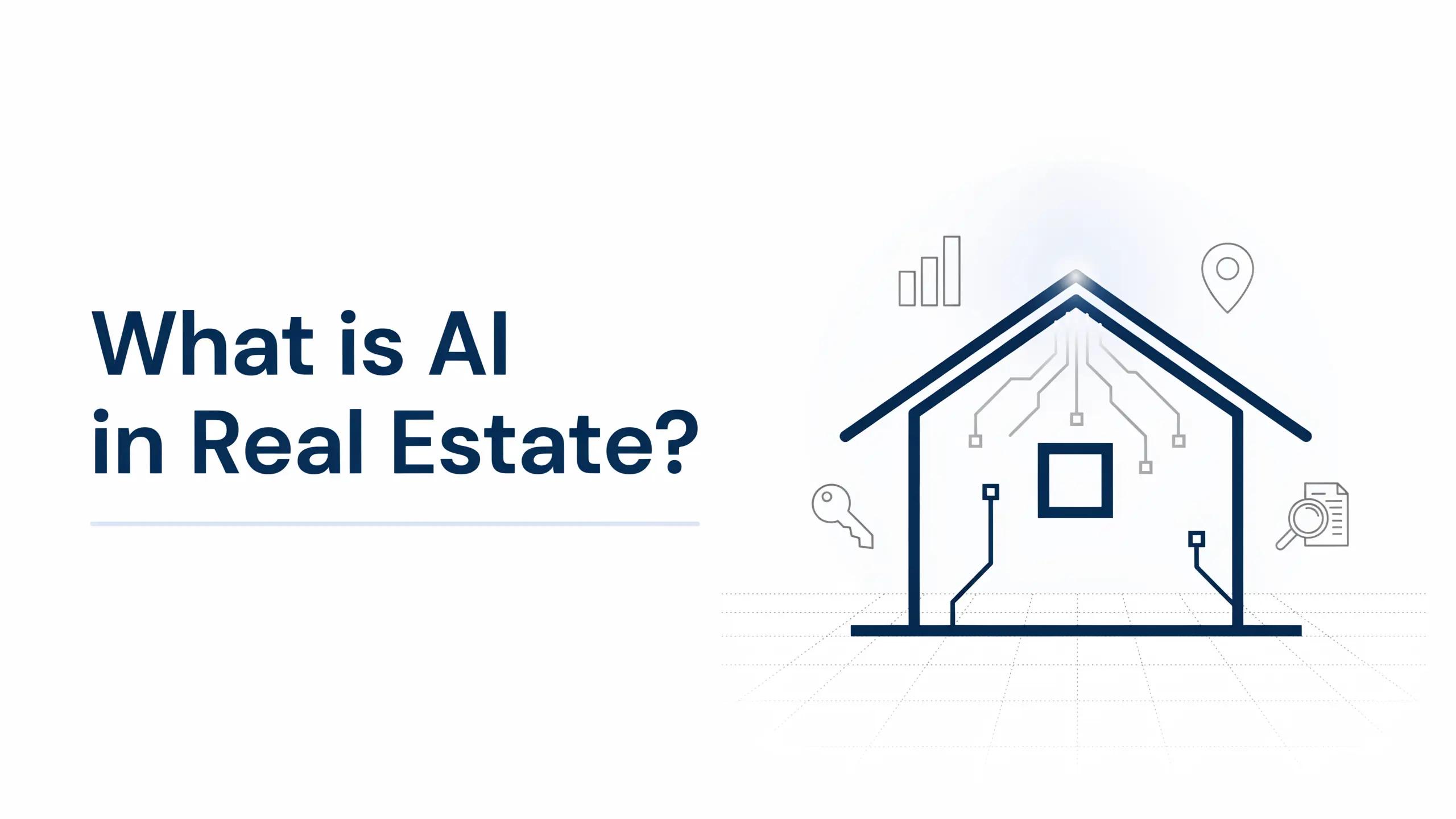
AI in real estate refers to the application of artificial intelligence to improve real estate workflows by automating repetitive tasks and extracting insights from structured and unstructured data. It also supports faster operational, commercial, and investment decisions. (You can read more on Ciphernutz's real estate AI and automation services page covering what we build in production.)
Why is AI Becoming Important In Real Estate?
Real estate has historically been slower than other industries to modernize its core operations, since it's a relationship business built on paperwork. Plus, the incentives to digitize weren't always obvious when a good agent's network mattered more than their tech stack. That's changed for a specific set of reasons, not because AI became fashionable.
1. Growing Operational Complexity
A single commercial lease can run 40+ pages of clauses on renewal terms, escalation schedules, and maintenance obligations. A portfolio of a few hundred units means thousands of individual data points that used to live in someone's memory or a shared spreadsheet. As portfolios and deal volume grow, the cost of manual review grows linearly with them, and AI is one of the few ways to break that linear relationship.
2. Labor Shortages and Workforce Efficiency
Property management in particular runs on a thin bench: leasing agents, maintenance coordinators, and portfolio analysts are hard to hire and expensive to retain. Automating the repetitive parts of those roles, like first-touch chat, maintenance triage, and document intake, lets existing teams handle more volume without proportional headcount growth.
3. Changing Buyer and Tenant Expectations
People who get instant answers from every other app they use don't tolerate a two-day wait for a listing question or a maintenance acknowledgment. According to the February 2026 RPR survey, 82% of real estate agents have already integrated AI tools into their daily work, largely because the alternative is losing responsiveness to a competitor who has adopted it.
4. Rising Operating Costs
Marketing spend, staffing costs, and interest rates all raise the bar for what counts as an acceptable cost-per-lead or cost-per-unit-managed. AI-enabled targeting and automation are among the few levers that reduce cost without reducing service quality, which is why the global AI-in-real-estate market is projected to grow from USD 2.9 billion in 2023 to USD 41.5 billion by 2033, a sustained double-digit growth curve, not a short-term spike.
5. Explosion of Real Estate Data
MLS feeds, IoT sensor data from smart buildings, public records, market comps, and buyer behavior signals now generate more structured data per property than a human analyst can reasonably synthesize. Machine learning and predictive analytics exist specifically to make that volume usable.
6. Competitive Pressure
Once Zillow, Redfin, Compass, and a growing list of brokerages built AI into core products, AI stopped being a differentiator and started being table stakes. Firms that haven't adopted it aren't behind on innovation; they're behind on baseline service expectations.
How AI Works in Real Estate
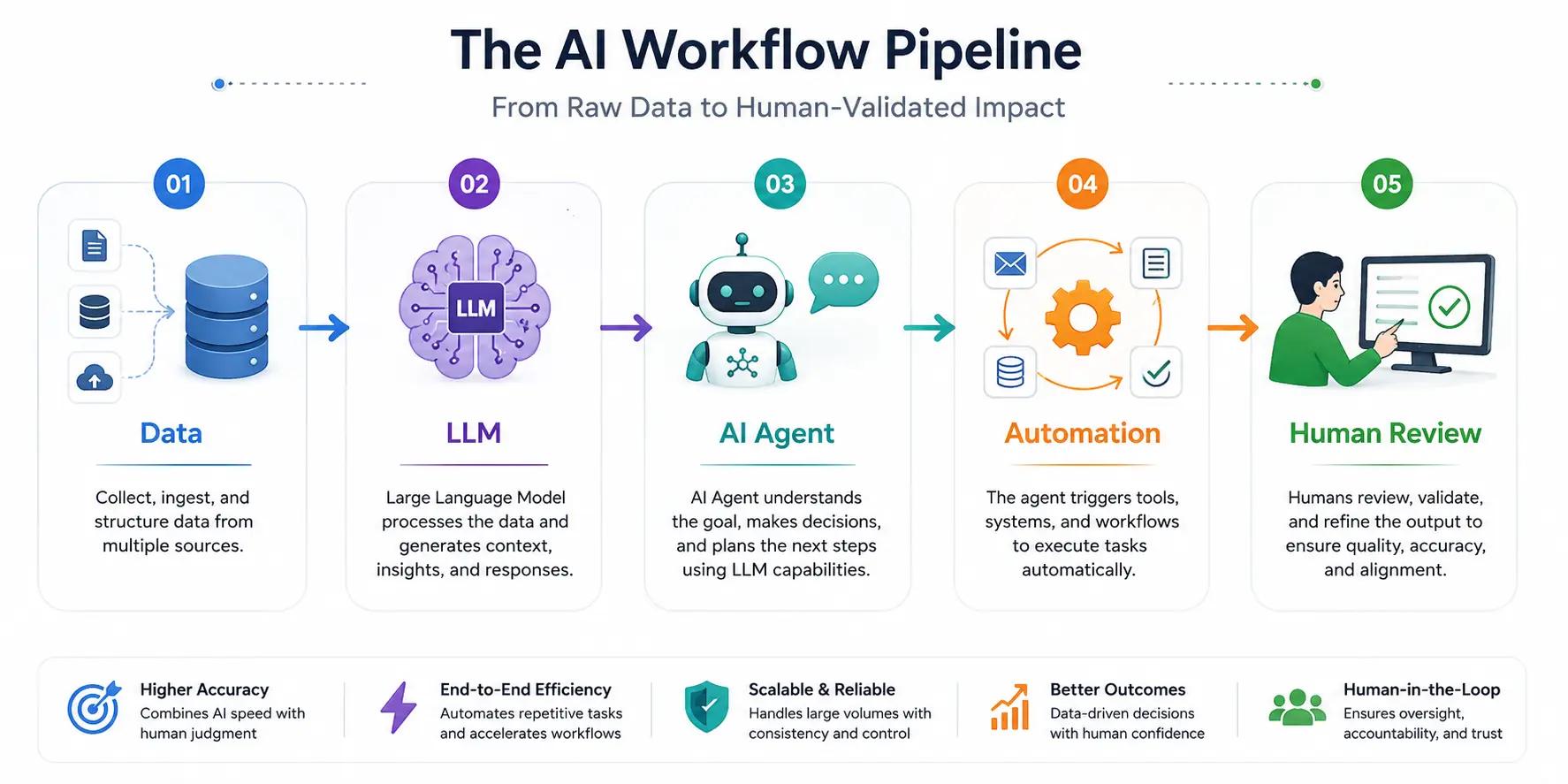
Most production AI systems in real estate, irrespective of the specific use case, follow the same basic pipeline, moving from raw data to a completed action:
The AI Workflow Pipeline
Data → LLM → AI Agent → Automation → Human Review
Data
It is the starting point and the actual bottleneck in most deployments. This includes MLS listings, lease documents, maintenance logs, CRM records, IoT sensor feeds, and market comps. AI quality is capped by data quality; a valuation model trained on incomplete comps produces confident, wrong answers, which is why data cleanup is usually the least glamorous and most important part of any real estate AI project.
LLMs (large language models)
They handle the unstructured side of that data: reading a lease and extracting the renewal clause, summarizing an inspection report, and answering a tenant's question in plain language. Many production systems pair an LLM with retrieval-augmented generation (RAG), a technique that lets the model pull from your specific documents and records at query time instead of relying only on its general training. It is what keeps answers grounded in your actual portfolio instead of a generic average.
AI Agent
They sit on top of the LLM layer and add the ability to act, not just answer. An agent handling a maintenance request classifies urgency, checks the vendor schedule, and creates a work order. The difference between a chatbot and an agent is that a chatbot ends its job at generating text; an agent continues on to take the next step.
Automation
It connects the AI layer to the systems that actually run the business, i.e., the CRM, the property management platform, accounting, and the MLS. This is typically where a workflow tool like n8n sits: routing an AI agent's output into the right system, triggering the next step, and logging what happened for an audit trail. Without this layer, AI output stays trapped in a chat window instead of doing work.
Human Review
Performing human review is the final and, for anything client-facing or high-stakes, non-negotiable step. Contract terms, pricing decisions, and anything that touches fair housing compliance get a human sign-off before they go out. It is primarily so because the cost of an unreviewed error (a wrong lease term, a discriminatory ad targeting pattern) is high enough. Hence, the review step pays for itself even when it catches nothing.
The systems that work well in production are the ones that get this pipeline right end to end. A great LLM connected to messy data, or a great automation layer with no human review of the output, both fail in predictable ways.
AI Agents in Real Estate: A Preview
Because agents are the newest layer in that pipeline and the one generating the most current interest, they get a full section of their own later in this guide, covering assistants versus agents versus multi-agent systems, and where agentic workflows are already production-ready versus still experimental.
See more about AI Agents in Real Estate below, or jump straight to Ciphernutz's AI Agent Development page if you already know you want to scope one.
Types of AI Used in Real Estate
Real estate AI isn't always one technology; it's five distinct categories. Each is suited to a different kind of task. Knowing which one you're actually asking for is the difference between a scoped project and an open-ended one.
Generative AI
Generative AI produces new content from a prompt: listing descriptions, lease summaries, marketing copy, staged property photos. It's the category most people picture when they hear "AI in real estate" because it's the most visible.
Suppose a listing description that used to take an agent 30 minutes now takes a few seconds of drafting and a review pass. The output still needs a human edit before it goes live, both for accuracy and for fair housing language compliance, but the first-draft time savings are real and immediate.
Predictive AI
Predictive AI forecasts an outcome from historical and current data: a property's likely sale price, a tenant's likelihood to renew, a building system's probability of failure in the next 90 days. This is the oldest and most mature category in the industry, as automated valuation models (AVMs) have existed in some form for over a decade. Fortunately, it's still where AI delivers the most measurable ROI, because the output is a number you can benchmark against actual outcomes.
Conversational AI
Conversational AI covers chatbots and voice assistants that handle first-touch interactions: answering a listing question at 11 pm, qualifying a lead before a human agent gets involved, and taking a maintenance request over the phone. This technology today runs modern systems built on LLMs that handle multi-turn, open-ended conversations and only escalate to a human when the conversation genuinely requires one.
Computer Vision
Computer vision reads images and video: tagging rooms in a listing photo set, flagging low-quality or non-compliant photos before publication, generating 3D tours from a phone scan, and assessing property condition from inspection photos. Matterport's Cortex AI engine, which builds 3D digital twins from photo and LiDAR capture, is a widely used example of this category in production today.
AI Agents
AI agents are systems that don't just generate an answer but take the next action inside a defined workflow. For instance, they perform tasks like triaging a maintenance ticket, qualifying and routing a lead, monitoring a data feed, and flagging an exception. This is the fastest-growing category and the one with the least standardized tooling, which is exactly why it needs its own section rather than a paragraph.
Most real production systems combine two or more of these, i.e., a conversational AI front end backed by predictive AI for pricing, wrapped in an agent that decides what to do with the conversation's outcome. Treating them as five isolated tools rather than a stack is the most common mistake in how this space gets evaluated.
AI Applications Across Real Estate
AI in real estate isn't one workflow, and it looks different depending on which side of the business you're on. Here's how it breaks down by domain.
Residential
On the residential side, AI shows up earliest in property search and lead engagement: natural-language search that lets a buyer describe what they want instead of filtering by bedroom count, AI chatbots that qualify inbound leads before an agent's time is spent, and automated valuation models that give buyers and sellers an instant price estimate to anchor a conversation.
Zillow's 2023 natural-language search launch and its Listing Showcase format are the most visible examples of this in the wild; Redfin runs a comparable AI-based listing match on its own platform.
Commercial
Commercial real estate leans harder on the analytical side of AI: lease abstraction across large, complex portfolios, tenant risk scoring, and market analysis that used to require a dedicated research team.
Deal cycles are longer, and stakes are higher per transaction, so commercial AI tools tend to prioritize accuracy and auditability over speed - a wrong number in a $40 million lease matters more than a slow chatbot response.
Property Management
Property management is where AI has arguably delivered the most consistent day-to-day ROI, because the workflows are high-volume and repetitive: predictive maintenance flagging HVAC or plumbing failures before they become emergencies, AI-managed tenant communication, and automated work order routing.
Ciphernutz's own property management automation work has cut manual property management tasks by more than 60% for clients. It is a result that comes from routing sensor alerts, work orders, and vendor notifications through n8n rather than a manual dispatch process.
Investment
For investment teams, AI's value is in a filtering scale that a human analyst can't cover manually: screening thousands of listings against target return criteria, flagging properties with weak fundamentals before capital is committed, and forecasting market movement across multiple submarkets at once.
This is less about replacing analyst judgment and more about making sure the analyst's time goes to the properties worth a second look.
Construction
On the construction and development side, AI applications center on project timeline forecasting, budget variance prediction, and computer-vision-based progress tracking from site photos or drone footage compared against the original plans.
This is a newer and less mature application area than the others on this list because most tools here are still closing the gap between pilot and standard practice. Simultaneously, the ROI case tends to be strongest on larger, multi-phase developments where a delay or budget miss compounds across the whole project rather than a single unit.
Facilities
Facilities management overlaps with property management but is distinct at scale; think large commercial or institutional portfolios rather than individual rental units.
AI here manages energy optimization, access control, and HVAC scheduling through connected IoT sensors, with predictive maintenance models doing failure-prevention work across a bigger and more complex physical footprint.
The business case is usually energy cost first and equipment lifespan second: catching a failing compressor before it fails outright both avoids an emergency repair bill and extends the life of the unit.
Common AI Use Cases in Real Estate
These are the flagship applications worth understanding individually, each with its own dedicated deep dive.
1. Automated Valuation (AVM)
Automated valuation models process comparable sales, neighborhood trends, and property-specific features to generate a price estimate in seconds instead of the hours a manual comp analysis takes. Ciphernutz's own AVM deployments for real estate clients have reported appraisal error rates falling from about 20% to 3–5%.
2. Lease Abstraction
AI extracts key terms like rent escalations, renewal options, maintenance obligations, termination clauses, etc., from lease documents that used to require a paralegal or analyst to read them line by line. For portfolios with hundreds of leases, this turns a multi-week review project into a same-day one.
3. Maintenance Triage
Incoming maintenance requests get classified by urgency and category automatically, routed to the right vendor, and tracked through resolution. In turn, it cuts the lag between "tenant reports a leak" and "plumber is scheduled" from days to minutes in well-built systems.
4. Lead Qualification
AI chatbots and scoring models handle first-touch questions, qualify buyer or tenant intent, and route only the leads worth a human's time to an agent. This performs better than an agent manually working every inbound inquiry, regardless of quality.
5. Listing Generation
AI drafts property descriptions, tags key features from photo batches, and selects the strongest images automatically, cutting the manual write-up and curation time that used to eat into an agent's day.
A description that took 30 minutes to write and check against MLS field requirements now takes a few minutes of drafting plus a review pass. The time savings come from the first draft, not from skipping the human edit that fair housing compliance still requires.
6. Investment Research
AI-powered models scan market data and thousands of listings to flag properties with weak fundamentals or surface underpriced opportunities against target return criteria. Resultantly, its screening is at a scale that manual research can't match.
For a fund or family office evaluating dozens of markets at once, this shifts an analyst's week from manually pulling comps toward reviewing a shortlist the model has already narrowed down.
7. Contract Review
Beyond lease abstraction specifically, AI extracts key terms across purchase agreements and closing documents, flags missing or inconsistent clauses, and tracks compliance deadlines automatically.
Ultimately, it's reducing the manual cross-referencing that document verification and title review traditionally required.
8. Market Analysis
Predictive models forecast price movement, absorption rates, and demand shifts at the submarket level from historical and real-time data, giving brokers and investors a data-backed starting point instead of relying purely on an anecdotal read of a market. This matters most in fast-moving submarkets, where the gap between an agent's gut sense and what the data actually shows tends to be widest.
9. Virtual Tours and Visual Marketing
Computer vision generates 3D virtual tours from photo or phone-scan capture, letting buyers walk through a property remotely, auto-highlights key rooms and features, and cleans up video walkthroughs before publication. It fundamentally reduces the number of in-person showings needed to close a serious buyer.
Matterport's Cortex AI engine is a widely used example of this category, building a navigable 3D digital twin from a standard phone scan rather than requiring specialized camera equipment.
Each of these use cases works as a scoped, standalone project, which is exactly why they're built out as their own cluster articles rather than fully explained here. If one of them matches a real bottleneck in your operation, the deep dive is the next step; if you're not sure which one applies, that's what an AI Readiness Audit is for.
Benefits of AI in Real Estate
Strip away the individual use cases, and the business case for AI in real estate comes down to six outcomes.
Higher Productivity
Automating listing drafts, document review, first-touch chat, and follow-up sequences frees agents and analysts to spend their time on the parts of the job that actually require a person, i.e., negotiation, client relationships, judgment calls.
Faster Decision-Making
An AVM returns a price estimate in seconds instead of hours; a lease abstraction tool surfaces a renewal deadline instantly instead of after a manual document review. Speed compounds: a faster valuation means a faster listing decision, which means a faster time-to-market.
Lower Operating Costs
Every task automated is a task that no longer scales linearly with headcount. Property management automation that cuts manual tasks by more than 60%, as it has for Ciphernutz clients, translates directly into either lower operating costs per unit or the ability to manage more units without adding staff.
Better Customer Experience
Instant responses to listing questions, same-day maintenance acknowledgment, and personalized property matching based on actual behavior rather than static filters raise the baseline experience buyers and tenants expect.
Improved Compliance
Automated tracking of lease deadlines, contract terms, and regulatory requirements catches what manual tracking misses, particularly across large portfolios where a single missed renewal notice or compliance deadline carries real financial risk.
Consider this: a single overlooked escalation clause on a large commercial lease can cost more than an entire year of the tooling that would have caught it.
More Accurate Forecasting
Predictive models process more market signals faster than a human analyst can manually synthesize. This gives investment and portfolio decisions a data-backed starting point rather than a purely intuition-driven one. That doesn't remove judgment from the decision; it only changes what the judgment is being applied to, from raw data synthesis toward interpreting a model's output.
These six outcomes compound when they're stacked on the same workflow rather than treated as separate initiatives.
A property management deployment that automates maintenance triage tends to also improve compliance tracking and tenant experience simultaneously, because they're drawing on the same underlying data pipeline. That's also why they aren't evenly distributed across every deployment: a poorly scoped AI project, built on bad data or without a clear owner, delivers none of them. The next section covers why that happens and what to watch for.
Challenges of AI Adoption
The gap between AI's potential and its realized value in real estate comes down to a specific set of recurring obstacles, not a fundamental limit on the technology itself.
Poor Data Quality
AI models are only as accurate as the sales, market, and portfolio data feeding them. A valuation model trained on incomplete or outdated comps produces confident, wrong estimates, and a lease abstraction tool trained on inconsistently formatted documents misses clauses it should catch. Most failed AI projects fail here, not at the model layer.
Bias in Training Data
Historical sales and lending data can encode decades of discriminatory patterns, and a model trained on it without deliberate correction can skew valuations or lead scoring against certain neighborhoods or buyer profiles. It's a problem that requires active governance, not a one-time model check.
Accuracy and Reliability
In the RPR survey referenced earlier, 63% of respondents named output accuracy as their top AI concern. It ranked higher than any other issue, including cost or job displacement. That concern is well-founded in cases where AI output goes out to clients without a human review step.
AI Governance
According to Delta Media Group's 2026 brokerage leadership survey, 49% of leaders reported being highly concerned about AI guardrails, up from 42% the year before. This suggests adoption is outpacing the internal policy and oversight structures meant to govern it at almost every brokerage surveyed.
Integration Challenges
Most brokerages and property managers run on a patchwork of legacy CRM, MLS, and accounting systems that weren't built to talk to an AI layer. The unglamorous work of connecting those systems (not the AI model itself) is usually the longest part of any real deployment timeline.
Change Management
Agents and property managers who've built their process around a manual workflow for years don't adopt a new AI tool just because it exists; adoption requires the tool to be faster and more reliable than what it replaces from day one, or it gets quietly abandoned.
None of these are reasons to avoid AI adoption. They're the reasons a scoped pilot with a defined success metric beats a broad rollout every time.
AI Agents in Real Estate
AI agents are worth a dedicated section here because they're the category generating the most current search interest, the most commercial urgency, and (not coincidentally) the most confusion about what the term actually means.
AI Assistants vs AI Agents
An AI assistant answers questions and drafts content when asked; it's reactive, and a person decides what happens with its output. A listing description generator or a lease-summarization tool is an assistant.
An AI agent goes further: given a goal and a defined set of tools, it takes multi-step action toward that goal without a person directing each individual step. A maintenance-triage agent doesn't just tell you a request looks urgent; it also checks vendor availability, creates the work order, and notifies the tenant, within the guardrails a person sets up in advance.
Multi-Agent Systems
A multi-agent system coordinates several specialized agents toward a larger goal, like one agent qualifying a lead, handing off to a second agent that schedules a showing, and handing off to a third that follows up post-showing. In this manner, each agent is handling a narrower task than a single general-purpose agent would.
Where Do AI Agents Work Best in Real Estate?
The reason agents matter more in real estate than the term's general hype suggests is that real estate workflows are naturally multi-step and rules-based. A lease renewal, a maintenance request, a lead qualification sequence each follow a fairly predictable path from trigger to resolution, which is exactly the kind of structured, repeatable process agentic systems handle well.
Where Do AI Agents Need To Work Better in Real Estate?
Areas where AI agents still need close supervision are anything that touches pricing decisions, contract terms, or client-facing communication with legal or compliance weight. Moreover, the human-review step from the pipeline section above isn't optional there.
If you're evaluating whether an agent makes sense for a specific workflow, Ciphernutz offers AI Agent development package - a fixed-scope, fixed-price way to validate an agent against your actual data before committing to a full build, and AI Agent Development for production builds once a use case is validated.
Industries Using AI in Real Estate
AI adoption isn't uniform across the real estate sector; the specific applications and maturity level shift depending on the asset type.
Residential
Residential brokerages lead on consumer-facing AI because the buyer-facing experience is the most visible, most competitive part of the funnel.
Commercial
Commercial real estate leans toward analytical and document-heavy AI for lease abstraction, tenant risk scoring, market analysis, etc., reflecting longer deal cycles and higher per-transaction stakes.
REITs
REITs and large institutional portfolios use AI primarily for portfolio-level forecasting and risk modeling, where the scale of the holdings makes manual analysis genuinely infeasible rather than just slow.
Hospitality
Hospitality real estate (extended-stay, short-term rental portfolios) applies AI heavily to dynamic pricing and demand forecasting, borrowing techniques closer to revenue management in the hotel industry than to traditional residential leasing.
Industrial
Industrial real estate across warehouses, logistics, and distribution uses AI for site selection and demand forecasting tied to supply chain and e-commerce growth patterns, plus computer vision for facility monitoring.
Facilities Management
Facility management organizations, spanning multiple asset types, are the heaviest users of predictive maintenance and IoT-driven building automation, since the sensor infrastructure required to make that AI useful tends to already be in place for other operational reasons.
Adoption maturity generally runs highest in residential and property management, where use cases are well-defined and the tooling is mature, and lowest in construction and hospitality-adjacent asset types, where the tooling is newer and more fragmented.
Future of AI in Real Estate
The near-term trajectory for AI in real estate is less about new capabilities appearing from nowhere and more about the capabilities that already exist becoming more autonomous, more integrated, and more personalized.
Agentic Workflows
Agentic workflows will keep expanding from single-task automation (triage one maintenance ticket) toward coordinated multi-step processes (triage, schedule, procure, close out with a person reviewing only the exceptions the system flags rather than every step).
Autonomous Operations
Autonomous operations will grow within narrow, well-governed boundaries, letting property management systems handle a growing share of the routine decision chain without human sign-off on every action, while keeping pricing, contracts, and anything with compliance exposure under continued human review.
Voice AI
Voice AI will mature past scripted phone trees into genuine multi-turn conversation for lead intake, tenant communication, and even portions of the negotiation process. It must be noted that Voice AI is following the same trajectory conversational AI has already taken in chat.
Digital Twins
Digital twins will move from being marketing tools to operational tools. The same 3D capture technology is currently used for buyer tours, extending into ongoing facilities management, tracking physical changes to a property over its lifecycle rather than just at the point of listing.
Hyper-Personalization
Hyper-personalization will deepen on the buyer and tenant side, with matching and recommendation systems drawing on richer behavioral signals than today's stated-preference filters, closer to how other consumer industries already personalize discovery.
Integrated AI Platforms
Tighter integration between AI and core systems like CRM, MLS, and property management platforms, syncing in real time rather than with batch updates. It will do more to unlock these gains than any single new model capability, because the biggest current bottleneck is integration debt, not AI capability.
What doesn't change: none of this replaces the parts of real estate that run on trust, negotiation, and local expertise. The trajectory is toward AI absorbing more of the repetitive middle of the workflow, not the relationship-driven ends of it.
Getting Started with AI in Real Estate
The firms that get real value from AI adoption follow a version of the same sequence, and the ones that struggle usually skip a step in it.
1. Identify Repetitive Work
Before evaluating any tool, identify the specific task eating the most hours relative to its complexity. Think maintenance triage, lease abstraction, and first-touch lead response are common starting points because they're high-volume and rules-based.
2. Audit Your Data
The most common reason AI pilots underperform isn't the model; it's incomplete, inconsistent, or siloed data feeding it. Know what data you actually have, where it lives, and how clean it is before scoping a build.
3. Choose One Workflow
A narrow, well-defined pilot can be one use case, one measurable outcome. It succeeds far more often than a broad "AI transformation" initiative with no single owner or metric.
4. Measure ROI
Define what success looks like based on error rate, time saved, and cost per unit. It must be done before the pilot starts, not after, so you have something concrete to compare the result against.
5. Scale Proven Workflow
Once a pilot proves out, the fastest path to a second use case is extending the same data pipeline and automation layer, not starting over with a new tool for every workflow.
This is close to the exact sequence an AI Readiness Audit is built to run, i.e., assessing your data, identifying the highest-ROI first workflow, and scoping a pilot before any commitment to a full build.
The Conclusion
AI in real estate today is a portfolio of specific, high-value automations that perform valuation, leasing, maintenance triage, and lead qualification. These are stitched together by workflow automation through AI agents that take action rather than just generate content.
It's not a single technology, and it's not close to running the business end-to-end; the firms getting real ROI from it are the ones treating it that way. Instead, picking one well-defined workflow at a time delivers better results than chasing a broad transformation with no clear owner.
If you already know which workflow is costing you the most time, the fastest next step is to scope it directly: explore Ciphernutz's real estate AI and automation services. You can also book a free scope call to map your first use case.
Frequently Asked Questions
What is AI in real estate?
AI in real estate is the use of machine learning, natural language processing, computer vision, and autonomous AI agents to automate property search, valuation, leasing, marketing, management, and transactions.
Is AI replacing real estate agents?
No. AI automates data-heavy tasks like valuation, document review, and first-touch lead response, but negotiation, trust-building, and local market expertise still require a human agent. The RPR survey's own concern data (accuracy as the top issue) reflects an industry treating AI as a tool under supervision, not a replacement.
What's the difference between an AI assistant and an AI agent in real estate?
An assistant generates content or answers for a person to act on, like a listing description or a lease summary. An agent takes the next action itself, inside defined guardrails, by creating the work order, not just flagging that one is needed.
How much does AI automation cost for a real estate business?
Cost depends heavily on scope. Ciphernutz's n8n automation engagements, for example, start around $3,500 for a fixed-scope project; a full AI Agent developpment package or MVP build runs higher depending on complexity and integration requirements.
What AI tools do real estate companies use most?
Per RPR's 2026 survey, the most common are AI writing tools for listings, chatbots for lead response, and automated valuation models for pricing.
How accurate are AI property valuations (AVMs)?
Accuracy varies by data quality and market, and well-built AVMs meaningfully outperform rough manual estimates. Ciphernutz's own AVM deployments have reported appraisal error rates falling from around 20% to 3–5% for clients.
What's the biggest risk in adopting AI for real estate?
Data quality and governance, not the AI models themselves. Poor or biased training data produces confidently wrong valuations or skewed lead scoring, and weak governance around AI-generated client-facing content creates compliance exposure.
Do I need a data science team to adopt AI in real estate?
No. Most production deployments today are built on existing platforms and workflow automation tools rather than custom models built in-house. An AI Readiness Audit is designed specifically to identify what's feasible without that internal capability.
Can AI handle fair housing compliance risk on its own?
No. AI-generated marketing copy, chatbot responses, and lead scoring all carry fair housing compliance risk if unreviewed, which is exactly why human review remains a required step for anything client-facing, not an optional one.
What real estate workflows should NOT be automated yet?
Final pricing decisions, contract negotiation, and anything requiring genuine relationship judgment remain human-led in essentially every mature deployment. AI supports these with data, but doesn't make the call.
Does Ciphernutz build AI real estate software?
Yes. Ciphernutz builds AI-powered real estate software, including AVMs, lead scoring, AI agents, and property management automation. See our real estate AI and automation services for details.
How long does a typical AI pilot take to show results?
It varies by use case, but a narrowly scoped pilot with one workflow and clear success metrics will typically show measurable results within weeks rather than months. It is the whole point of starting narrow instead of broad.