This guide is for:
- Category Managers
- Retail Directors
- Merchandising Teams
- Inventory Managers
- Retail Operations Leaders
- CIOs evaluating AI initiatives
Managing a retail category has never been more challenging.
Customers' demands change rapidly, competition sets daily price changes, and with thousands of SKUs, more data is created than any human staff can analyze. By the time reports are reviewed and decisions are made, valuable opportunities are often already gone.
That's the reason why more retailers pay attention to AI agent development.
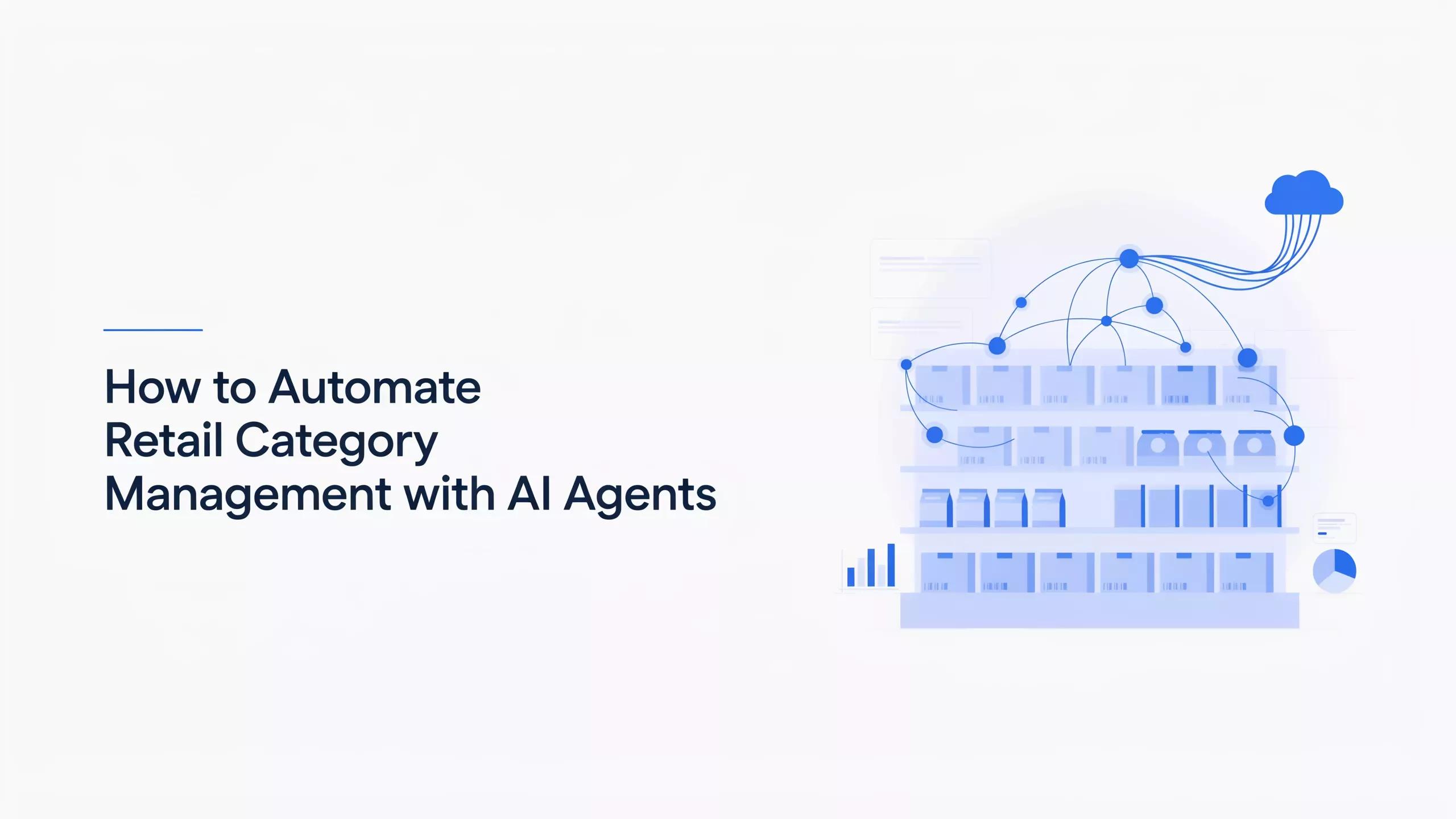
AI agents can track performance in real-time, recognize pricing, inventory, and assortment opportunities and perform actions approved by category managers. Instead of wasting time on data analysis, category managers will have more time for strategies.
However, many businesses didn't understand how to automate retail category management with the help of AI agents.
Don't worry, we have got you covered!
In this guide, you will learn:
- What is retail category management really about
- Why manual and rules-based automation are not enough
- Tasks related to the category that can be automated with the help of AI agents
- Step-by-step guide to successful deployment
- Potential challenges, best practices, and how to choose a partner
By the end of this article, you will know which category-related tasks should be automated and how to keep control.
What Is Retail Category Management?
The retail management category is a way for managing an assortment of goods that fall under a particular category like beverages, dairy, or electronics into a business unit.
This involves the selection of products, pricing, promotions, managing the stock of products, and placing them in ways that maximize their sale.
In simple terms, the goal is to ensure that the right products reach the right people through proper pricing and revenue generation.
With growth in the size of the category, many retailers are now using AI agents to accomplish these goals.
How Retail Category Management Works (Before AI)
Supplier
↓
Purchase
↓
Inventory
↓
Pricing
↓
Promotion
↓
Sales
↓
Customer Feedback
↓
Optimization
AI agents can automate almost every stage of this workflow.
Why Traditional Category Management Can't Keep Up?
The tools most category teams rely on were built for a slower retail world. They struggle the moment volume, speed, and channels increase.
Here is where the old approach breaks down:
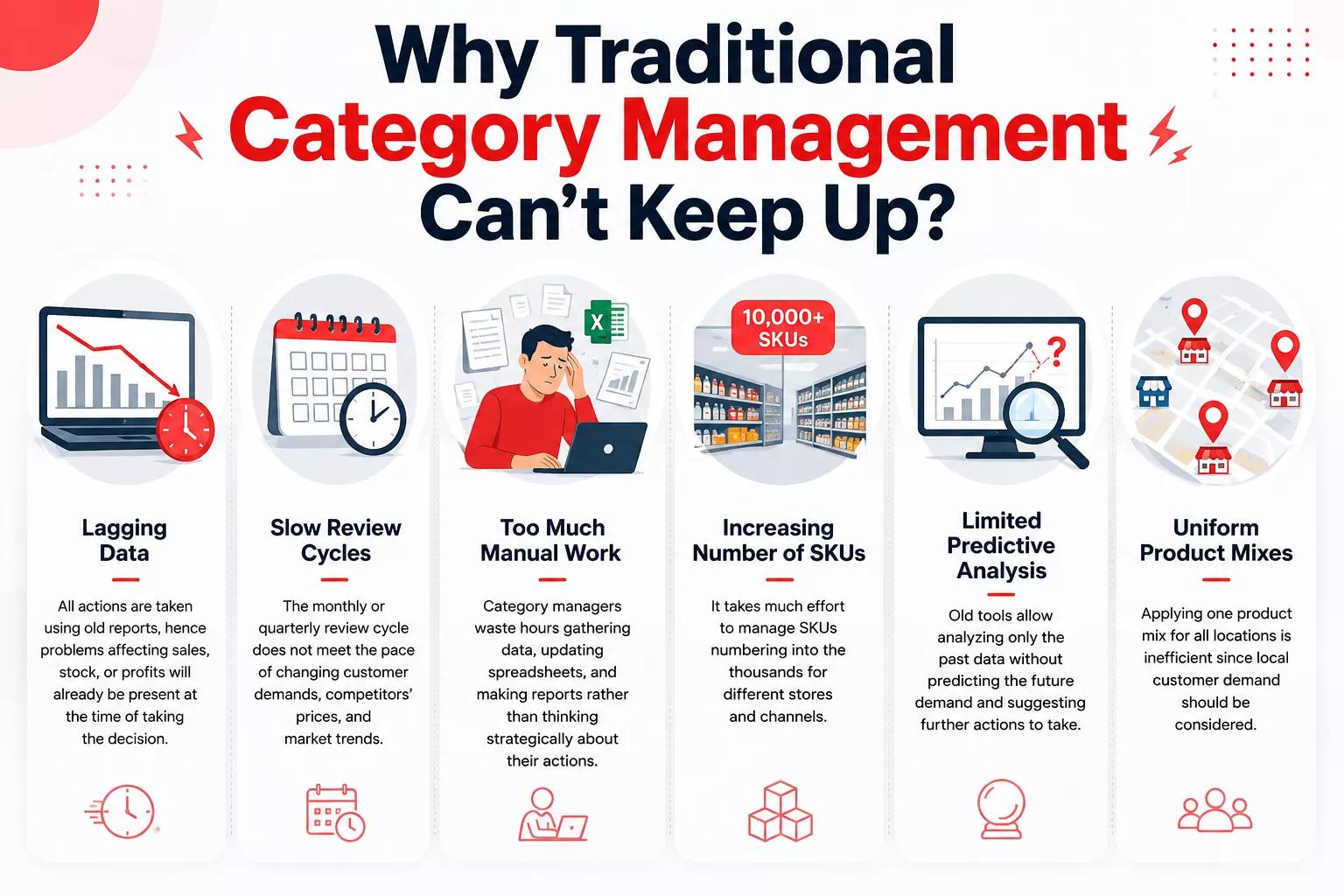
- Lagging Data: All actions are taken using old reports, hence problems affecting sales, stock, or profits will already be present at the time of taking the decision.
- Slow Review Cycles: The monthly or quarterly review cycle does not meet the pace of changing customer demands, competitors' prices, and market trends.
- Too Much Manual Work: Category managers waste hours gathering data, updating spreadsheets, and making reports rather than thinking strategically about their actions.
- Increasing Number of SKUs: It takes much effort to manage SKUs numbering into the thousands for different stores and channels.
- Limited Predictive Analysis: Old tools allow analyzing only the past data without predicting the future demand and suggesting further actions to take.
- Uniform Product Mixes: Applying one product mix for all locations is inefficient since local customer demand should be considered.
Each of these gaps costs a margin every single week. Knowing how to automate retail category management with AI agents is how you close them.
The CAPE Framework™ for Retail AI Automation
C
Collect Data

↓

A
Analyze Patterns

↓

P
Prioritize Decisions

↓

E
Execute Actions
What Does It Mean to Automate Retail Category Management with AI Agents?
Automated retail category management with AI agents refers to the use of intelligent technology that analyzes data, makes identifications, provides recommendations, and even implements actions automatically.
Unlike traditional automation that is done according to predetermined guidelines, AI agents are capable of comprehending the dynamic environment, dealing with huge data volumes, and modifying their recommendations to match the current situation.
To put it simply, AI agents assist category managers in making more informed and rapid decisions by performing most of the analysis and action implementations manually.
If you want the basics first, our guide on what AI agents are explains the core idea clearly.
What Do AI Agents Actually Do?
- Collect and Analyze Information: The AI agents collect sales information, inventory levels, price, and information related to suppliers and then derive useful information.
- Recommend a Plan of Action: They will detect any problems like slow-moving items, price adjustments, low inventory levels, decreasing margins, and recommend the best course of action.
- Take the Action: If authorized, they will be able to make price changes, generate purchase orders, and take other actions as needed.
This is the difference between a reporting dashboard and an agent. One just tells you what to do and the other works with you.
Example: Imagine a grocery retailer with 250 stores.
An AI agent detects that bottled water demand is increasing in coastal locations due to an upcoming heatwave. It forecasts inventory shortages, recommends replenishment quantities, checks supplier availability, and creates purchase orders. The category manager simply reviews and approves the recommendations instead of spending hours analyzing spreadsheets.
Traditional Automation vs AI Agents for Category Management
The fastest way to understand how to automate retail category management with AI agents is to see the shift side by side:
| Aspect | Traditional / Rule-Based Automation | AI Agents |
|---|---|---|
| Decision logic | Follows fixed, pre-set rules | Reasons over live context and adapts |
| Data it handles | Structured data only | Structured and unstructured data together |
| Adaptability | Breaks when conditions change | Learns and adjusts as patterns shift |
| Scope of work | Single, isolated task | Multi-step workflows across systems |
| Action taken | Sends alerts or fills dashboards | Executes approved changes end-to-end |
| Human role | Manual follow-up on every output | Approves and oversees, the agent does the work |
| Output | Tells you what happened | Tells you what to do, then does it |
Which Retailers Need AI Agents?
| Retail Size | Recommended AI |
|---|---|
| Small | Inventory Agent |
| Medium | Pricing + Forecasting |
| Large | Multi-Agent System |
| Enterprise | Full AI Orchestration |
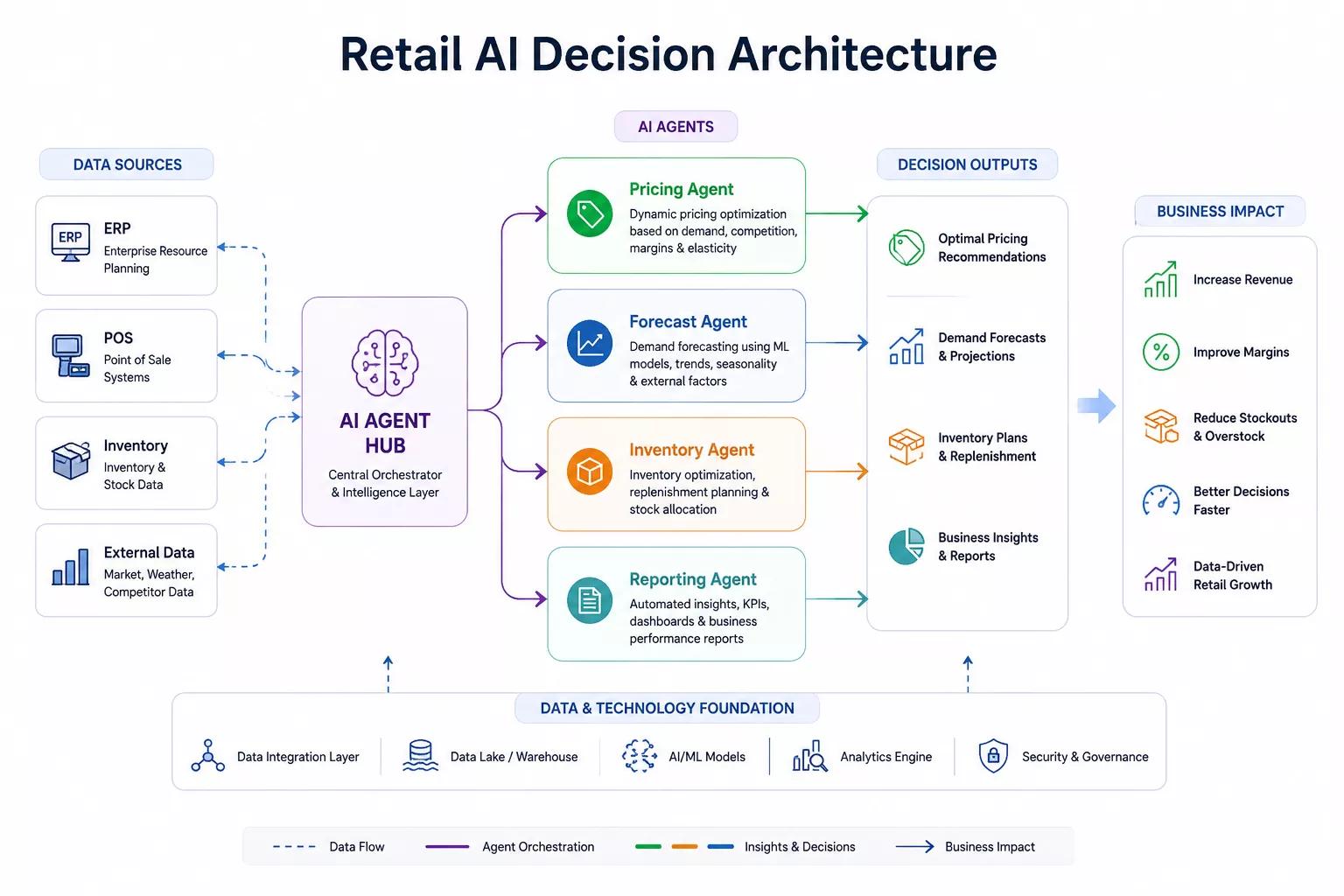
Retail AI Decision Architecture
7 Reasons Why Automate Retail Category Management with AI Agents
Here are seven gains that show up fast when you learn how to automate retail category management with AI agents:
1. Faster, Always-On Category Decisions
Your categories never stop moving, so decisions should not wait for a weekly meeting. AI agents watch performance around the clock and flag the action the moment it is needed. You fix a pricing gap or stock risk while it still matters, not after the margin is gone.
2. Less Time Lost to Manual Data Pulls
Most category managers lose hours every week just gathering and formatting data. Agents handle that grind for you by pulling, cleaning, and reconciling data from every system automatically. Your time shifts from building reports to making sharper calls, which is where your expertise actually pays off.
3. Higher Forecast Accuracy and Fewer Stock Errors
Guesswork at the SKU level is expensive in both directions. AI agents forecast demand using real signals like seasonality, promotions, and local trends, so you stock what each store truly needs. The result is fewer stockouts on top sellers and far less cash tied up in slow inventory.
4. Protected and Improved Category Margins
Margin leaks quietly through wrong prices, weak promos, and missed markdowns. Agents catch these leaks continuously and recommend the fix within the guardrails you set. McKinsey research points to efficiency gains of 15-30% from automating non-value-added categories and procurement work, which flows straight to your bottom line.
5. Localized Assortments That Match Real Demand
A range that wins in one store can sink in another. AI agents cluster stores by real demand patterns and tailor the assortment to each group, not to a head-office average. You sell more per square foot and carry less dead stock, without adding manual effort.
6. Consistent Execution With a Full Audit Trail
Manual processes tend to deviate, while decisions can get lost in translation between teams. Agents enforce the logic consistently every single time and record every change made in a full audit trail. This allows you to enjoy a better governance process and an easy review.
7. Category Managers Freed for Strategic Work
Automation is not about reducing people. It is about eliminating mundane tasks so that you can focus on your strategy. Your agents do all the heavy lifting of data and implementation, leaving your team to work on supply strategy and range development.
Expected Business Impact After AI Automation
| KPI | Before | After AI |
|---|---|---|
| Stockouts | High | Low |
| Margin | Lower | Higher |
| Forecast Accuracy | Moderate | High |
| Reporting Time | 6 hrs | 10 mins |
Retail Category Management Tasks You Can Automate with AI Agents
You do not automate everything at once. The smart move is to assign focused voice AI sales agents and category agents, each owning a clear job.
Here are eleven high-value tasks to target as you plan how to automate retail category management with AI agents:
1. Assortment Optimization
Assortment optimization via AI represents one of the most obvious wins. The AI looks at local demographics, sales history, and demand clusters to determine which product assortment should be available for each store or geographic location. It identifies SKUs with low rotation and predicts the consequences prior to any changes.
2. Dynamic Pricing and Markdown Management
Pricing by gut feel leaves money on the table, and AI dynamic pricing in retail fixes that. The agent adjusts markdowns and promotions in real time, always inside your margin guardrails. It calculates price elasticity at the SKU level and protects profit while staying competitive.
3. Replenishment and Stock Allocation
Manually-driven restocking leads to both out-of-stock and over-stocking situations. An AI replenishment agent helps to predict stock requirements, dynamically set reorder points and create purchase orders directly in your ERP system. That is an example of automated replenishment and inventory optimization working silently behind the scenes.
4. Demand Forecasting at SKU-Store Level
While chain-level forecasts may mask actuality on the store level, a forecasting agent takes sales history, seasonality, promotions, even the weather into account to make accurate forecasts on the SKU-store-day level. Such precise forecasts enable more efficient replenishment based on the actual demand of every individual store.
5. Promotion Planning and Incrementality Analysis
An uplift rate may greatly distort the actual efficiency of the promotion. An agent differentiates the incremental sales from regular sales and cannibalization and suggests appropriate depth and schedule of promotional activities for maximum effectiveness and minimum margin erosion.
6. Automated Margin and Performance Reporting
Weekly performance packs are the single biggest time sink for most category teams. An agent pulls sales, margin, and mix data, reconciles it with promo calendars and supplier funding, and builds the report for you. Better still, it arrives with proposed actions, so you validate decisions instead of compiling slides.
7. Natural-Language Category Analytics
A question ought to elicit an answer immediately, without having to rely on the analyst to do it. With natural language analytics, all you have to do is ask questions about why the category was lower in one geographical area, and receive an immediate answer.
Also Read: 25 Best AI Agent Development Companies for SMBs
Now you've seen what agents handle, let's look at how to automate retail category management with AI agents step by step.
How to Automate Retail Category Management with AI Agents: Step-by-Step
Here are the steps to automate your category management using AI agents:
Step 1. Define Your Goals and Understand Your Current Process
First, figure out what you want to fix. For instance, do you want to minimize stockouts, increase margins, have better inventory management, or reduce the time spent on report creation?
Once you understand your goal, study your current category management process to find those tasks that are redundant, take much time to complete, and are prone to mistakes. It's the perfect candidate for automation.
Step 2. Identify the Best Use Cases for AI Agents
Not everything should be automated. Start with finding a few key cases that will allow you to see results immediately.
For instance, you can assign demand forecasting to one AI agent, inventory replenishment to another one, and pricing suggestions to yet another one. This way, the system becomes more manageable.
Step 3. Connect the AI Agents to Your Data and Systems
In order to make good decisions, AI agents must have access to the right information. It means linking them to such systems as your POS, inventory management, ERP, suppliers, and e-commerce.
With all data being connected, agents will have the ability to analyze what is going on in the company and make better recommendations.
Step 4. Set Clear Rules and Human Approval Processes
AI agents should not be permitted to make any decisions without limits. In this case, you need to establish certain rules that would guarantee the safe operation of agents.
For example, you could permit an agent to propose price changes, but in cases when a discount is bigger than 15%, then the manager's approval will be required. Such rules will minimize risks but at the same time give the chance for automation to help save some time.
Step 5. Run the Agents in a Testing Environment
Before letting agents make decisions on their own, you could run it for several weeks in the testing environment. It means that at this stage agents analyze data and propose actions, while people still make the ultimate decision.
Step 6. Measure Results and Validate Performance
After experimenting with agents, determine whether they really make the business processes better. Monitor relevant KPIs such as accuracy of forecasting, inventory turnover rate, frequency of stockouts, category margins, and savings in time.
If the outcome is good, you will know that the agents are ready for more significant tasks. Otherwise, you may optimize the system prior to its scaling.
Step 7. Scale Automation Gradually
As soon as an AI agent starts providing good recommendations on a regular basis, you can let it perform more actions or roll out across more categories of products.
Rather than implementing all automation right away, it is better to scale gradually. That way, you minimize risks and help your staff adjust to the change.
6 Challenges of Automating Category Management with AI Agents (and How to Solve Them)
Understanding these obstacles early can help you plan better and avoid costly mistakes:
Challenge 1. Poor Data Quality and Data Silos
AI agents use data to make their recommendations and decisions. But many retail businesses have data stored in multiple sources, like spreadsheets and databases, which don't exchange information with each other. In cases when the data used is incomplete, old, or inaccurate, it is very hard for the AI agents to provide reliable insight, forecasting, and recommendations.
Solution: Develop a central data platform prior to launching AI agents. It is important that your sales, inventories, pricing, suppliers' and customers' data be up-to-date, accurate and complete.
Challenge 2. Governance, Compliance, and Accountability
When using AI agents in pricing, inventory planning, and promotions, you have to stay in control over crucial decisions. Absence of governance can lead to difficulties in understanding what decisions were made and by whom.
Solution: Establish workflow processes and control over access. Every action performed by AI agents has to be monitored and traced.
Challenge 3. Lack of Trust in AI Recommendations
Not all of the category managers are willing to follow AI's recommendations, as they cannot understand the reasons behind them. In case an agent makes any suggestions regarding pricing, SKU deletion or any other changes, employees may be unwilling to take action.
Solution: Use agents who give a clear explanation of why they gave certain recommendations. It is always a good idea to test agents first before using them on real data.
Challenge 4. Over-Automation and Loss of Control
The main mistake that retailers make when implementing AI agents is over-automation. The process of automation, especially of something like pricing, promotions and other aspects, should have some limitations.
Solution: Set rules from the very beginning and leave some actions exclusively for human managers to approve or disapprove.
Challenge 5. Integrating AI with Existing Systems
There are many cases where retail enterprises have old-fashioned ERPs, POSs, inventory management systems, and supplier systems. Thus, it may be quite difficult to integrate AI agents in such systems that were not developed for modern AI solutions.
Solution: The key thing is to use AI technologies that support API integration and are compatible with the existing tech stack of the company. It helps to avoid the necessity of system replacement while adding new features.
Challenge 6. Employee Resistance and Change Management
Employees may be afraid of replacement by AI agents or radical changes in their job responsibilities. In such a case, there will be difficulties in implementation and overall project success.
Solution: It should be mentioned that AI agents are meant to assist employees in performing their tasks. Category managers need to be engaged from the very beginning, and adequate training should be provided to show how automation eliminates the routine tasks of employees.
Also Read: Top 15 AI Agent Development Companies in the UK
Best Practices for Automating Retail Category Management with AI Agents
Keep these eight best practices in mind as you work out how to automate retail category management with AI agents:
1. Start With One Category, Not Your Entire Catalog
Instead of trying to implement all automation processes at once, it is better to start with one category of products where you see some value and which has the least amount of dirty data. It is better to learn something from the first attempt and then apply this experience further.
2. Build a Clean, Unified Data Foundation First
Every strong agent rests on strong data, so this comes before the fancy stuff. Standardize your metrics and connect your sources so the agent sees one consistent view across systems. Time spent here pays back many times over in accuracy and trust later.
3. Use Specialized Agents Instead of One Mega-Agent
A single mega-agent system will probably be inefficient as there will be many tasks that this mega-agent will try to handle. That is why it is better to split the tasks between several specialized agents, and it will be much easier to test and improve each of them.
4. Keep Margin and Safety-Stock Guardrails Non-Negotiable
The main idea of guardrails is to keep everything safe; therefore, they must always be non-negotiable. Before running an agent into a production environment, set up strict guardrails for discount level, safety stock and other things.
5. Blend Structured and Unstructured Data Signals
Sales figures only reveal one side of the whole process. In order to get the most accurate recommendations, agents need to receive structured data as well as unstructured signals.
6. Connect Agents to Real Systems, Not Just Dashboards
An idea that does not get executed by anyone adds no value. Hook up agents directly to your ERP, PIM, and e-commerce software so that they make the transition from analytics to execution. Execution is when automation starts paying off.
7. Track Business Outcomes, Not Only Model Accuracy
An awesome algorithm without any impact on real business metrics means nothing. Measure actual business outcomes like margin, stockouts, and time savings, not just technical accuracy scores. Measuring the right things helps you build the right systems.
8. Review and Retrain Agents as Demand Shifts
Market demands evolve and if you leave an agent to its own devices, it will slowly lose its edge. Set a schedule for periodic reviews and training so that its performance will stay on track.
How to Choose the Right AI Agent Development Partner
Here are some key factors to consider while choosing the right AI agent development partner:
- Proven Track Record: Go with a partner who has demonstrated experience building and deploying real AI agents for actual companies.
- Works with Your Current System: You want to partner with an organization that will be able to implement the AI agents with your current ERP, PIM, POS, and any other systems in place without needing to make major system modifications.
- Good at Integrating Systems: A partner whose team is skilled at integrating data and systems together to guarantee the success of the AI agents.
- Includes Security and Controls: Your partner must have processes in place for providing audit trails, controls, and security measures.
- Focusing on Business Results: Work with a partner who concentrates more on getting you business results such as improved margins and reduced stockouts than fancy AI technology.
- Continued Support: You'll always have to update and monitor the AI agents even after implementation.
Why Choose Ciphernutz to Automate Your Retail Category Management?
The outcome of an AI project often comes down to much more than just having the necessary technologies. The success of an AI project can be achieved by the team developing it.
We've helped businesses across multiple industries build AI-powered solutions integrated with ERP, CRM, POS, and custom enterprise platforms. One consistent lesson is that retailers achieve the fastest ROI when they begin with one high-impact workflow before expanding to multiple AI agents.
What sets us apart?
- Experience: 60+ successful cases and 98% of client satisfaction.
- Client-oriented approach: we help to solve business tasks, not implement new technologies.
- Integration with existing systems: we build AI agents that are compatible with ERP, PIM, CRM, POS, and other systems you use.
- Professional integration expertise: We integrate the data flows, processes, and tools into one system.
- Trust around the world: we build our solutions for 20+ countries.
- Continuous monitoring and improvement: we keep track of your agents' operations and constantly improve them.
Ready to automate your retail category management?
Book a free consultation call with our AI experts to identify the best automation opportunities and create a clear implementation plan for your business.
Conclusion
Understanding how to automate retail category management with AI agents allows retailers to increase decision-making speed, decrease the effort required and improve the category performance.
The secret is in taking baby steps, working with relevant use cases, and scaling up as you go along.
With the right approach and the right technology provider, AI agents will help you streamline your operations and remain strategic.
We hope this guide was useful for you in understanding how AI agents can revolutionize retail category management and where to start your automation journey.
Now it is time for you to take the next step and decide which category processes can be automated to deliver the best benefits.
Ready to get started? Contact our AI experts and discover where AI can create the biggest impact in your retail business.
FAQs
What is retail category management automation with AI agents?
The use of AI agents to automate the execution of category activities like assortment, pricing, replenishment, and reporting with minimal involvement from people. The agents collect data, make recommendations, and take action on any decisions made by people in your systems.
Which category management tasks should I automate first?
Begin with category management activities that are highly disruptive and repetitive and whose underlying data is very clear, such as margin reporting, demand forecasting, or replenishment. You get quick and noticeable wins to build trust. After success, move ahead gradually into pricing, assortment, and promotions automation.
How much does retail AI automation cost?
The cost of retail AI automation depends on your business size, number of integrations, data readiness, and the complexity of AI agents. A focused pilot project typically costs significantly less than a full enterprise deployment. Most businesses start with one or two high-impact use cases, such as inventory optimization or demand forecasting, before expanding to pricing, promotions, and multi-agent workflows.
Can AI agents integrate with SAP, Oracle, Microsoft Dynamics, or other ERP systems?
Yes. Modern AI agents integrate with leading ERP, POS, CRM, and inventory management platforms through APIs, middleware, or custom connectors. Whether you use SAP, Oracle, Microsoft Dynamics 365, NetSuite, Shopify, or a custom ERP, AI agents can securely exchange data to automate pricing, inventory, procurement, and reporting while preserving your existing workflows.
Do AI agents replace category managers?
No, they eliminate the grunt work so that managers have time for strategic decisions. Agents do the data pulls, reporting and execution, whereas category managers manage suppliers, plan ranges and make strategic decisions.
How long does it take to automate retail category management with AI agents?
It depends on the readiness of the data and the scale of implementation; however, focused implementations will go within weeks rather than months due to agents' integrations with existing systems. Usually, the process starts from a 30 to 60-day shadowing period to demonstrate value and then scaling up to live execution.
How do AI agents handle seasonal demand and demand fluctuations?
AI agents continuously analyze historical sales, seasonal trends, promotions, holidays, weather patterns, and local demand signals to improve forecasting accuracy. Unlike traditional forecasting models that rely on fixed rules, AI agents adapt as new data becomes available, helping retailers reduce stockouts, avoid overstocking, and optimize inventory during seasonal peaks and demand fluctuations.