More than 80% of healthcare organizations are using or exploring AI. Nearly two-thirds of real estate brokerages have already embedded AI into at least one workflow. Yet adoption alone doesn't explain competitive advantage. These 80+ statistics reveal where AI is actually creating measurable value and why workflow architecture now matters more than model selection.
Key Findings
- Healthcare AI adoption has crossed the threshold from experimentation to broad operational use, with most organizations already adopting or exploring it.
- Real estate AI is winning where workflows are structured and revenue-linked, especially lead routing, listing generation, and valuation.
- AI agents show the biggest upside when they reach production, but most projects still stall before deployment.
- Workflow automation delivers the clearest infrastructure-level ROI because it connects systems, not just tasks.
- Voice AI is expanding quickly because it improves response time, qualification speed, and appointment setting.
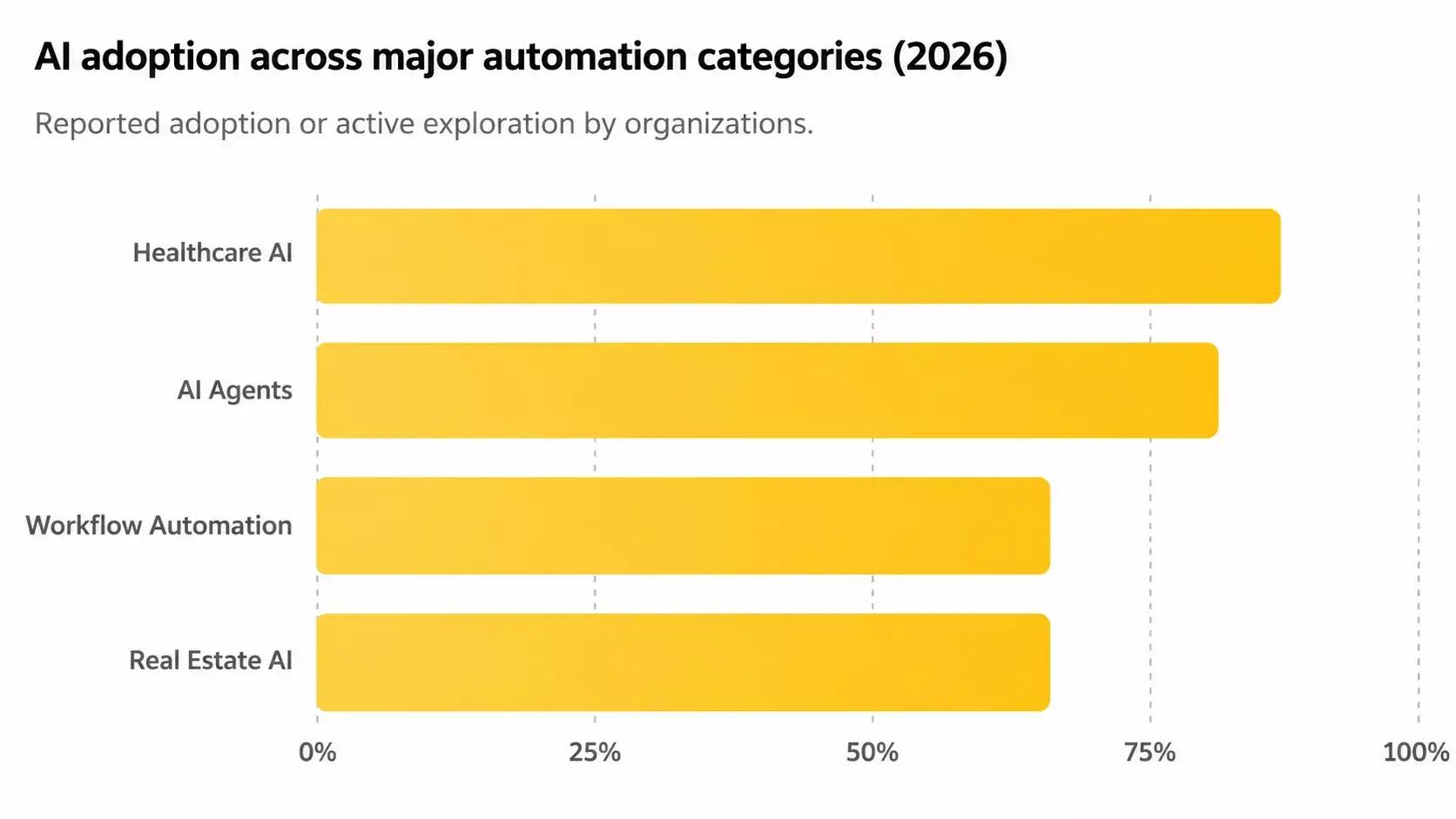
Note: Statistics in this report were compiled from publicly available industry reports, enterprise surveys, research publications, analyst reports, and market forecasts published between 2024 and 2026. Where multiple sources reported similar metrics, preference was given to the most recent or broadly cited publication.
Adoption Is Not The Whole Story
AI adoption numbers matter, but they are not the real insight. The more important question is where AI creates durable business value and what kind of operating model is required to sustain it. McKinsey’s recent coverage of real estate and healthcare points to the same underlying shift: value comes from redesigning workflows and domains, not from adding isolated tools.
| Area | AI Adoption | ROI Signal | Largest Value Driver |
|---|---|---|---|
| Healthcare | 85% exploring or using AI | 82% report moderate or high ROI | Documentation and admin automation |
| Real estate | 64% of brokerages use AI | 69% report positive ROI | Lead routing and listing workflows |
| AI agents | 79% adopted in some form | 171% average ROI when deployed | Autonomous task execution |
| Workflow automation | 65% use automation platforms | 400% average ROI in year one | Cross-system orchestration |
| Voice AI | Growing across verticals | Faster response and higher conversion | Intake, qualification, scheduling |
Real Estate AI Statistics 2026
Real estate is one of the clearest examples of AI’s practical value because the workflows are repeatable, high-volume, and tied directly to revenue. The strongest use cases are the ones that reduce time-to-action, improve lead quality, and increase conversion efficiency.
Market Adoption And Spend
- 97% of brokerage leaders report their agents use AI
- 68% of agents use AI daily or several times weekly
- 92% of proptech platforms have shipped AI features
- AI underwriting returns 300 to 500% ROI within first 12 months
- 69% of brokerages report positive ROI from AI tools
- 52% of agents say AI saves them 4 or more hours per week
- Residential brokerages are projected to raise AI spend from $1.9B in 2025 to $2.7B in 2026
- Commercial real estate AI spend is projected to rise from $2.4B to $3.3B
- Proptech and portals are projected to rise from $3.6B to $5.2B
- Property management is projected to rise from $1.1B to $1.6B
Use Cases And ROI
- Listing description generation has 61% adoption
- Listing description generation shows 2.4x ROI
- Lead scoring and routing has 48% adoption
- Lead scoring and routing shows 3.1x ROI
- Automated valuation models have 44% adoption
- Automated valuation models show 2.8x ROI
- Virtual staging and photo enhancement has 39% adoption
- Virtual staging and photo enhancement shows 2.2x ROI
- Chat assistants on portals have 35% adoption
- Chat assistants on portals show 1.9x ROI
Related Case study: AI-Powered Real Estate CRM & Sales Automation
Expert Interpretation
The real estate numbers point to a simple truth: AI performs best when the workflow already has structure. Lead generation, listing creation, routing, and valuation are all repeatable enough for AI to improve them without requiring a complete operating redesign. That is why ROI is strongest in the middle of the funnel, where speed and consistency directly affect conversion.
This also explains why real estate AI should not be framed as “automation for its own sake.” The firms that win will connect AI outputs to CRM logic, showing workflows, follow-up sequences, and agent productivity. In other words, the competitive advantage is not the model - it is the system around the model.
Ciphernutz Perspective
The highest-performing real estate firms are not adopting AI one workflow at a time. They are connecting lead capture, qualification, CRM updates, property recommendations, and follow-up into a single automated operating model. That shift creates compounding ROI because every workflow strengthens the next instead of operating in isolation.
Healthcare AI Statistics 2026
Healthcare has the strongest trust requirement and one of the clearest efficiency cases. The numbers show a consistent pattern: organizations are starting with administrative automation, then moving into documentation, clinical support, and predictive systems.
Adoption And Investment
- 85% of healthcare organizations have adopted or explored AI
- 79% of healthcare organizations are actively using some form of AI technology
- 82% of healthcare organizations report moderate or high ROI from AI
- The global AI in healthcare market is projected to reach $110.61B by 2030
- The healthcare AI market is projected to grow at 38.6% CAGR from 2025 to 2030
- The healthcare chatbot market is projected at $543.65M in 2026
Administrative Automation And Documentation
- 60% of healthcare AI investment goes to administrative automation
- 100% of surveyed U.S. health systems have begun developing ambient clinical documentation
- U.S. healthcare avoided $258B in administrative costs in 2024 through automation
- 50%+ of health plans use AI in administrative workflows
- 25%+ of provider organizations use AI in administrative workflows
Clinical Deployment
- 90% of health systems have deployed AI for imaging and radiology
- 67% of health systems have deployed sepsis early detection
- 60% of health systems have deployed or are developing ambient clinical documentation
- 56% of health systems have deployed clinical deterioration risk tools
- 52% of health systems have deployed unplanned readmission prediction
- 51% of health systems have deployed in-basket message automation
- Radiologists using AI detect lesions 26% faster
Related: WhatsApp AI Appointment Agent for Clinic
Expert Interpretation
Healthcare AI is following a rational maturity path. First comes administrative relief, because that is where burden, cost, and delay are most visible. Then comes documentation and inbox automation, because these are the easiest to operationalize without compromising care. Clinical AI follows, but only after organizations build trust, governance, and workflow discipline.
That sequencing matters. Healthcare leaders are not buying AI simply because it is available; they are adopting it because staffing pressure, documentation load, and operational inefficiency leave them little choice. McKinsey’s healthcare coverage reflects this shift toward practical adoption and the rise of agentic AI as the next layer of value creation.
Ciphernutz Perspective
Healthcare organizations consistently achieve faster returns by automating administrative workflows before introducing higher-risk clinical AI. Documentation, patient intake, scheduling, and inbox management establish the governance, integration patterns, and organizational trust needed to support larger AI initiatives later.
Voice Agent Statistics 2026
Voice AI is one of the cleanest “speed-to-value” applications because it improves response time, scale, and appointment-setting without requiring a full process redesign. It is especially strong in real estate, but the same logic applies to healthcare, insurance, and recruiting.
Operational Value
- AI voice systems can qualify real estate leads 24/7
- AI voice systems can book showings without manual intervention
- Real estate voice AI can handle 1,000 calls per day
- Real estate voice AI delivers 99% faster response times
- Real estate voice AI can reduce costs by 20%
- AI voice agents deliver 3.1x higher real estate lead conversion than manual follow-up
- Voice AI is being adopted across healthcare, insurance, and recruiting use cases
- AI phone and voice tools are now used for mass calling and outbound automation
- Industry-specific voice AI adoption is being tracked as a growth category in 2026
- Voice AI is increasingly used for intake, qualification, and appointment-setting workflows
Expert Interpretation
Voice AI succeeds because it sits closest to the moment of demand. A lead calls, a patient asks for help, a candidate wants scheduling - and voice automation responds instantly. That response speed creates a measurable advantage before most teams even realize a human follow-up delay has occurred.
The important caveat is that voice AI is only as good as the workflow behind it. If calls are answered but not routed, logged, or followed up properly, the technology creates noise rather than value. This is why voice AI should be paired with workflow automation, CRM synchronization, and escalation logic.
Ciphernutz Perspective
Voice AI should never be deployed as a standalone communication tool. Its greatest value comes when every conversation automatically updates business systems, triggers downstream workflows, and hands off complex situations through governed escalation paths. Voice becomes another entry point into an intelligent operating system rather than another isolated channel.
AI Agents Statistics 2026
AI agents are where the hype is highest and the execution gap is widest. Adoption is broad, but production deployment remains limited, which makes this one of the most important categories to interpret carefully.
ENTERPRISE AI MATURITY

Level 5
──────────────────────────────────────────
Autonomous Enterprise
• Multi-agent orchestration
• Continuous optimization
• AI-driven operations
• Enterprise-wide governance

▲

Level 4
──────────────────────────────────────────
Production AI
• AI agents in production
• Workflow orchestration
• Monitoring
• Security
• Human oversight

▲
Level 3
──────────────────────────────────────────
Workflow Automation
• CRM integrations
• Business process automation
• Cross-system orchestration
• AI-assisted decision support

▲

Level 2
──────────────────────────────────────────
Functional AI
• Chatbots
• Voice AI
• Document generation
• Lead scoring
• Clinical documentation

▲

Level 1
──────────────────────────────────────────
AI Experimentation
• Pilot projects
• Individual productivity
• Isolated use cases
• Proof of concepts
Implementation Insight
Most organizations currently operate between Functional AI and Workflow Automation. The biggest leap in business value occurs when AI becomes part of governed production workflows with continuous monitoring, integration, and performance optimization. Advancing through these maturity levels is less about deploying more AI and more about improving operational architecture.
Adoption Versus Production
- 79% of enterprises have adopted AI agents in some form
- Only 11% of enterprises run AI agents in production
- 88% of AI agents never reach production
- 23% of organizations are already scaling an agentic AI system somewhere in the business
- 62% enterprise adoption is cited in 2026 market analysis
- 74% of companies are expected to use agentic AI within two years
ROI, Governance, And Scale
- Successfully deployed AI agents deliver 171% average ROI globally
- 66% of companies using AI agents have already seen measurable productivity gains
- 76% time savings has been reported versus manual task completion in agentic workflows
- Production AI agents save knowledge workers 4 hours per week
- 21% of companies have mature AI governance frameworks for autonomous agents
- 73% of companies cite privacy and security as their primary AI governance concern
- 55% of organizations prefer consumption-based pricing for AI agents
- The global AI agent market reached $10.9B in 2026
- 68% of healthcare organizations already use AI agents in some capacity
- 84% of respondents feel comfortable with AI making end-to-end autonomous decisions for specific processes
Expert Interpretation
AI agents are not failing because the idea is weak; they are failing because production requires more than prompt quality. Successful deployment depends on clear use-case boundaries, good data access, strong workflow design, and governance that prevents autonomous action from becoming uncontrolled action. That is why the adoption-to-production gap is the most important statistic in the category.
The market is still early enough that the winners will be defined by implementation discipline rather than model novelty. Enterprises that start with narrow, measurable use cases will build the credibility needed to scale into more complex agentic systems. That is the strategic role of an MVP-first approach.
Ciphernutz Perspective
Organizations that successfully move AI agents into production rarely begin with fully autonomous systems. They start with narrowly defined workflows, measurable success criteria, and strong governance before expanding into more complex orchestration. Controlled deployment consistently outperforms large-scale experimentation.
Workflow Automation Statistics 2026
Workflow automation is the infrastructure layer that turns AI into repeatable business impact. It is the clearest example of how systems thinking creates more value than isolated automation.
   CUSTOMER / USER
                                  │
                                  ▼
                     Voice AI / Web / Email
                                  │
                                  ▼
                     AI Intake & Classification
                                  │
                                  ▼
═══════════════════════════════════════════════════════════════
        GOVERNANCE • SECURITY • COMPLIANCE • MONITORING
═══════════════════════════════════════════════════════════════
                                  │
                                  ▼
                     Workflow Orchestration
                                  │
                  ┌──────────────┬──────────────┐
                  ▼              ▼              ▼
             CRM Update      AI Agent     Business Rules
                                 │
                                 ▼
                     Decision / Recommendation
                                 │
                ┌────────────────┴────────────────┐
                ▼                                 ▼
         Human Approval                  Autonomous Action
                │                                 │
                └────────────────┬────────────────┘
                                 ▼
                    Analytics & Performance Metrics
                                 │
                                 ▼
                   Continuous AI Optimization
Architecture Insight
Enterprise AI succeeds when governance is embedded throughout the execution layer rather than added afterward. Security, compliance, monitoring, and human oversight should surround every workflow so AI decisions remain observable, auditable, and aligned with business policies. This architecture enables organizations to scale voice AI, AI agents, and workflow automation with confidence instead of accumulating operational risk.
Market Adoption And Productivity
- 65% of organizations use automation platforms
- 52% of SMBs use automation platforms
- 60% of businesses had already implemented automation solutions in at least one workflow
- 40% of business users build automations without developer help
- Organizations run an average of 12 automations per company
- SMBs save 240 hours per year per employee with workflow automation
- Employee satisfaction increases by 32% when manual work drops
ROI And Operational Scale
- Workflow automation delivers 400% average ROI within the first year
- No-code automation adoption grew 45% year over year
- AI-enhanced workflows process 3x faster than rule-based automation
- 90% error reduction is reported in automated processes
- The global workflow automation market is projected to reach $27.91B in 2026
- The workflow automation market was valued at $23.77B in 2025
- 68% of IT leaders say AI workflows have already reshaped operations
- 78% of companies are using AI in at least one function
- AI workflow automation is increasingly viewed as the backbone of AI-powered businesses
Expert Interpretation
Workflow automation is where AI becomes operationally durable. A model can generate an answer, a voice agent can capture a lead, and an AI agent can draft a decision - but without automation, none of those outputs reliably move through the business. This is why workflow architecture is the most underestimated part of AI transformation.
The organizations that get the most value are not necessarily the ones with the most tools; they are the ones that connect systems across intake, routing, approvals, updates, and follow-up. That is also why workflow automation should be treated as the foundation for both voice AI and agentic AI.
2024
│
├── Automation focused on repetitive tasks
├── AI copilots gain mainstream attention
├── Administrative AI delivers first measurable ROI
│
▼
2025
│
├── Voice AI expands into customer-facing workflows
├── Workflow automation platforms become AI-enabled
├── Organizations begin experimenting with AI agents
│
▼
2026
│
├── AI becomes operational infrastructure
├── Multi-agent workflows enter production
├── Workflow orchestration becomes the competitive differentiator
├── Governance becomes a board-level priority
└── AI shifts from isolated tools to connected business systems
Market Insight
The progression from 2024 to 2026 reflects a broader change in enterprise priorities. Early AI adoption focused on individual productivity, while today's investments prioritize operational resilience, governed automation, and end-to-end execution. The next phase of competitive advantage will come from how well organizations integrate AI across entire business processes rather than from which models they adopt.
Ciphernutz Perspective
Workflow automation is where isolated AI capabilities become enterprise infrastructure. Every successful AI initiative eventually depends on orchestration across systems, approvals, monitoring, and business rules. Organizations that invest in workflow architecture early build a foundation that supports future AI agents, voice systems, and autonomous operations without repeated rework.
What The Numbers Really Say
These statistics do not point to five separate trends. They point to one connected shift: AI is becoming the connective tissue of modern operations. In real estate, it improves lead flow and listing productivity. In healthcare, it reduces administrative burden and supports clinical work. In voice, it accelerates response. In agents, it creates autonomy. In workflow automation, it makes the whole system run.
That is the Ciphernutz interpretation layer. The real opportunity is not to publish a list of statistics, but to show how those statistics reveal where value is forming, where execution is breaking, and where implementation maturity becomes a competitive advantage.
Ciphernutz Positioning Layer
Ciphernutz helps teams move from AI interest to AI implementation with a practical delivery model built around strategy, build, and operations. That matters because the biggest barrier in 2026 is no longer awareness - it is execution.
Where Ciphernutz Fits
- Real Estate: for implementing lead routing, listing workflows, portal assistants, and revenue automation.
- Healthcare: for implementing administrative automation, documentation, and governed clinical use cases.
- AI Workflow Automation: for connecting systems, routing work, and making AI operational.
- AI MVP Development: for teams that want a production-ready first build.
- AI Managed Pod: for ongoing implementation, optimization, and governance.
Final Takeaway
2026 is not the year AI became visible. It is the year AI became necessary. The strongest businesses will be the ones that treat automation, agents, and workflow design as connected infrastructure rather than isolated experiments.