Introduction: The Dilemma of 'Agentic' Scale
The AI landscape is shifting for the better in 2026. We are moving past the era of simple 'text-in, text-out' prompts and into the age of agentic AI solutions, i.e., systems that can capably reason, plan, execute tools, and verify their own work. For CTOs and automation leads, this evolution brings a critical question: 'Low-code tools are evolving, but can they handle the cyclic complexity of true autonomous agents?'
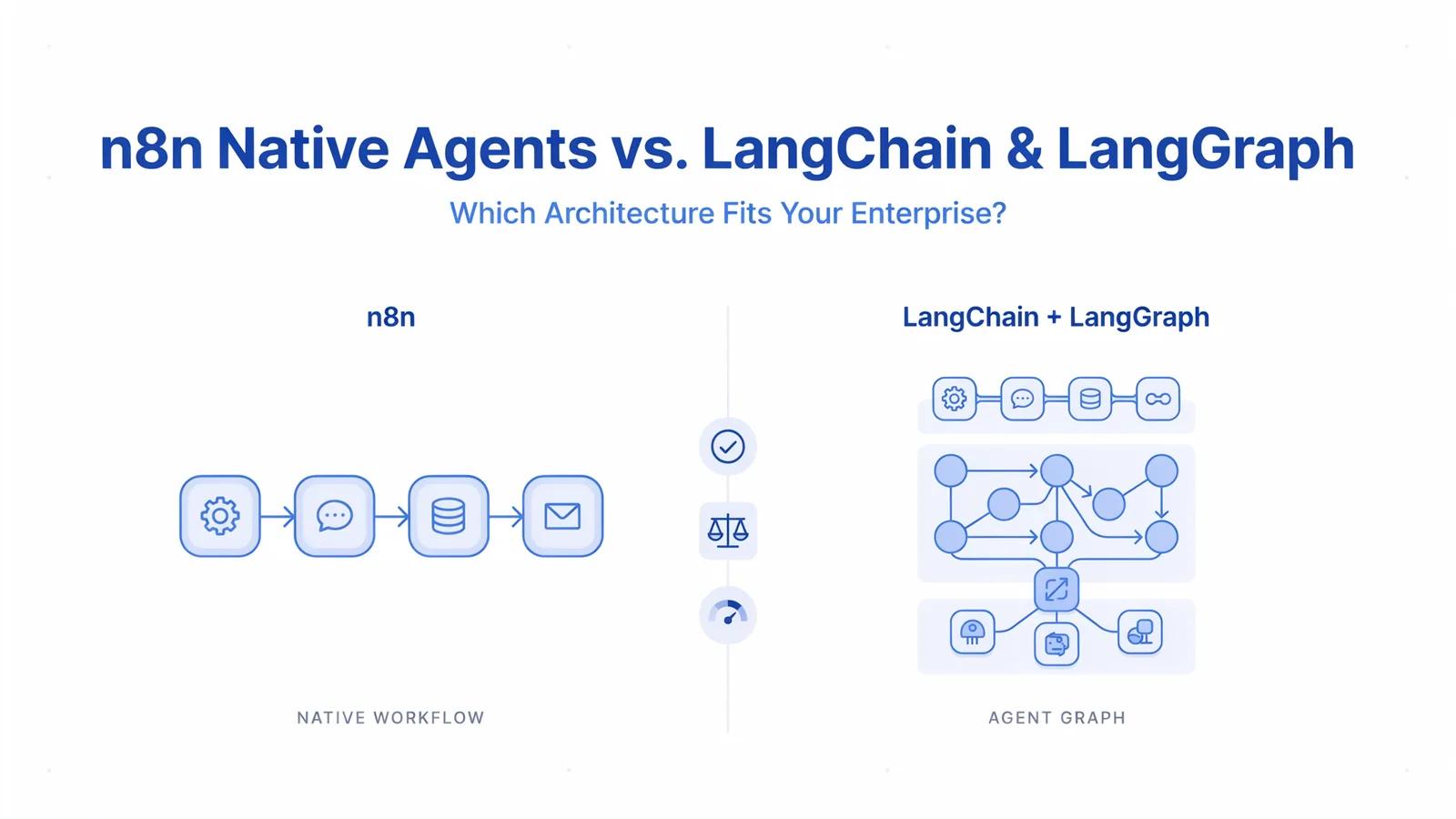
On one side, we have n8n Native, offering a visual, drag-and-drop AI Agent Node (which is actually powered by LangChain under the hood). It promises rapid deployment and easy observability. On the other side, we have Code-First implementations using raw LangChain or LangGraph in Python, offering granular control over state and logic.
Contrary to what is assumed, for 80% of standard enterprise use cases, n8n Native is more than sufficient because it offers superior maintenance speed. However, for the top 20% of complex, highly adaptive agentic AI solutions, a hybrid approach using n8n Python code is required.
Understanding n8n Native AI Agents (The 'Basic LLM Chain')
To make the right choice, you first need to understand the abstraction layer n8n provides. n8n has effectively wrapped the complexities of the LangChain library into pre-configured nodes, making the 'ReAct' (Reason + Act) loop accessible without writing a single line of Python.
The Evolution: n8n AI Agent vs. Basic LLM Chain
It is crucial to distinguish between a simple generative step and true agency. When we compare an n8n ai agent vs. (any) basic LLM chain, we are comparing linear processing against dynamic reasoning.
- Basic Chain (The Linear Path): This follows a strict $A \rightarrow B \rightarrow C$ topology. You send a prompt, get a completion, and pass that completion to a database. It is deterministic and excellent for tasks like summarization, translation, or sentiment analysis, where the output structure is predictable.
- AI Agent (The Cyclic Loop): This is non-linear. The n8n langchain agent node utilizes a reasoning loop. It accesses tools (functions), observes the output, and decides the next step. If the tool fails or the output isn't sufficient, it loops back to retry or choose a different strategy.
Pros of the Native Approach
- Rapid Deployment: You can spin up a RAG pipeline in minutes using the pre-built 'Vector Store' and 'Chat Model' nodes.
- Visual Debugging: In n8n's execution view, you can see exactly which tool was called and what data was passed. This transparency is often lost in pure code implementations without heavy logging infrastructure (like LangSmith).
- Ecosystem Integration: The real power is connecting the AI agent to n8n's 1,000+ other nodes (Slack, Gmail, Salesforce) without writing API wrappers.
Cons
- State Limitations: While great for single-turn or simple multi-turn conversations, managing complex state loops or multi-agent handoffs purely visually can result in 'spaghetti workflows.'
- Context Window Control: Native nodes abstract away some of the token management strategies (like specific sliding windows or summary buffers) that advanced developers might want to tune manually.
The Case for LangChain & LangGraph (Custom Code)
There comes a point in custom AI agent development where 'drag-and-drop' hits a wall. This usually happens when you need an agent to behave less like a chatbot and more like an employee with a long-term memory and a complex workflow.
When Code is King
This is where LangGraph enters the picture. Unlike standard LangChain, LangGraph is built specifically for building stateful, multi-actor applications with cyclic graphs.
1. State Management & Persistence
In a native n8n workflow, data flows from node to node. So, if an n8n workflow automation fails or restarts, the internal state of the reasoning engine often gets reset. The LangGraph, however, introduces the concept of a 'State Schema' that persists throughout the graph's execution.
- Why this matters: If you have an agent that needs to 'remember' it tried Strategy A five steps ago and failed, it needs a persistent state object, not just linear input/output data.
2. Granular Control:
If you need to implement specific cognitive architectures, like say 'Plan-and-Solve' or 'Reflexion' or others that aren't supported by n8n's out-of-the-box agent node, you need code. You might need to tweak the temperature dynamically based on the step of the chain, or swap models mid-execution (e.g., use GPT-4 for planning, but GPT-3.5 for summarizing).
The 'Python Node' Bridge
Here is the strategic unlock: You don't have to leave n8n to use LangChain. You can inject this logic directly via n8n Python code.
By importing LangChain libraries within an n8n Python node, you can execute a custom chain or graph that outputs a result, which n8n then routes to the next step.
Technical Deep Dive: Inside the Python Node
When you utilize the n8n Python code node, you aren't just writing scripts; you are defining a micro-architecture.
- Imports: You can import langchain_core, langgraph, and langchain_openai directly if you self-host n8n or use the appropriate Docker image.
- The Logic: You define your StateGraph in Python.
- The Handoff: The Python node accepts the JSON input from the webhook or trigger (e.g., { 'user_query': 'Analyze this CSV' }) and returns the final agent output as a JSON object that the next n8n node can read.
Practical Example: A Two-Agent Reflexion Loop Inside an n8n Python Node
Here is a working pattern for Scenario B above, condensed to its reusable core. It defines a two-node LangGraph state machine, a Coder and a QA reviewer, that loops until the code passes review or hits a retry ceiling. Paste this logic into an n8n Python Code node on a self-hosted instance.
# Runs inside the n8n Python Code node.
# Requires a self-hosted n8n instance with langgraph and your LLM client installed.

from langgraph.graph import StateGraph, END
from typing import TypedDict

class AgentState(TypedDict):
    ticket: str
    code: str
    review_score: int
    attempts: int

def coder_node(state: AgentState) -> AgentState:
    # Replace generate_code with your own LLM call, e.g. a LangChain
    # create_agent instance scoped to a coding system prompt.
    state["code"] = generate_code(state["ticket"], state.get("code"))
    state["attempts"] += 1
    return state

def qa_node(state: AgentState) -> AgentState:
    # Replace review_code with your own scoring LLM call or static analysis.
    state["review_score"] = review_code(state["code"])
    return state

def route_after_qa(state: AgentState) -> str:
    if state["review_score"] >= 80 or state["attempts"] >= 4:
        return "approved"
    return "retry"

graph = StateGraph(AgentState)
graph.add_node("coder", coder_node)
graph.add_node("qa", qa_node)
graph.set_entry_point("coder")
graph.add_edge("coder", "qa")
graph.add_conditional_edges("qa", route_after_qa, {"approved": END, "retry": "coder"})

app = graph.compile()

# n8n hands the Jira ticket description to this node as JSON input
result = app.invoke({
    "ticket": _input.first().json["ticket_description"],
    "code": "",
    "review_score": 0,
    "attempts": 0,
})

# n8n reads this return value and routes approved code to the GitHub node
return [{"json": {"approved_code": result["code"], "attempts": result["attempts"]}}]
This effectively turns n8n into a 'container' for your advanced Python logic, giving you the best of both worlds.
The generate_code and review_code functions are placeholders for your own model calls. The state graph, retry ceiling, and conditional routing are the reusable part, and the same pattern works for a Manager-Coder-QA loop by adding a third node ahead of the coder.
Need this built and wired to your Jira and GitHub instances rather than assembled from a blog post? Our n8n implementation team can scope and ship the full workflow.
Architectural Showdown: When to Use Which?
Let's look at two common enterprise scenarios to see how the architecture changes. We will break these down by Data Flow and Logic Requirements.
Scenario A: RAG Chatbot for Internal Docs
- The Goal: An HR bot that answers questions about company policy using a PDF knowledge base.
- Complexity Level: Low to Medium.
- The Verdict: n8n Native.
The Workflow Breakdown:
Trigger: Slack Mention or Webhook.
Vector Retrieval: Use the native n8n Vector Store node (Pinecone/Qdrant). This node handles the embedding generation and similarity search automatically.
Reasoning: The AI Agent Node receives the retrieved chunks and the user query. It uses a 'Chat Model' node (OpenAI/Anthropic) to synthesize the answer. Related: Reasoning in AI.
Action: The response is sent back to Slack.
- Why Native?
The reasoning here is straightforward: Retrieve $\rightarrow$ Generate. There are no complex loops or state changes required. The overhead of writing custom Python here would slow you down with no added benefit.
- Key Insight: This is the perfect use case for the standard n8n AI agent node langchain wrapper.
Scenario B: Autonomous Multi-Agent Software Dev Team
- The Goal: A system where a 'Product Manager' agent defines specs, a 'Coder' agent writes Python scripts, and a 'QA' agent reviews them, looping until the code passes.
- Complexity Level: High (Cyclic/Stateful).
- The Verdict: Hybrid / LangGraph.
The Workflow Breakdown:
1. Orchestration (n8n): The process starts with a Jira Ticket creation (Trigger). n8n extracts the ticket description.
2. The 'Black Box' (Python Node): n8n passes the description to a Python Code Node running LangGraph.
- Step 1 (Manager): Breaks down the task.
- Step 2 (Coder): Generates code.
- Step 3 (QA): Simulates/Reviews code.
- The Loop: If QA fails ($Score < 80$), the graph routes back to Step 2 with feedback. This loop happens inside the Python node.
3. Execution (n8n): Once the Python node returns the 'Approved Code,' n8n uses the GitHub Node to create a Pull Request.
- Why Hybrid?
Visually implementing a 'while loop' that passes context between three different agents in n8n is possible, but messy. You would need multiple 'If' nodes and intricate routing lines. It is cleaner to define the agent interaction in n8n Python code using LangGraph, and let n8n handle the inputs (Jira) and outputs (GitHub).
- Key Insight: Complex multi-agent systems often require the precision of code for the reasoning layer.
The 'Hybrid' Enterprise Architecture
At Ciphernutz, we believe the binary choice can be a false dichotomy. The most robust enterprise architectures use n8n as the Operating System and LangGraph as the Processor.
The Blueprint
This hybrid model allows you to scale custom AI agent development efficiently by adhering to a strict separation of concerns:
1. Orchestration Layer (n8n)
This layer handles the 'plumbing.' It manages Webhooks, API authentication, error handling, and data routing. It ensures the data gets to the agent.
- Role: The 'Body' of the agent.
- Responsibilities: Listening for triggers, formatting JSON, handling authentication tokens for 3rd party apps, and final delivery of results (e.g., sending the email).
2. Reasoning Layer (Code)
For complex tasks, we inject a Python node. This node runs the specific LangGraph workflow or complex LangChain logic.
- Role: The 'Brain' of the agent.
- Responsibilities: Managing memory, deciding on the next step, executing cognitive loops, and structuring the final answer.
3. Action Layer (n8n)
Once the agent decides to 'send email' or 'update CRM,' it passes a JSON object back to n8n.
- Role: The 'Hands' of the agent.
- Responsibilities: n8n executes the Gmail or Salesforce node based on the output from the Python node.
- Why this works: You get the reliability of n8n's integrations (no need to write a custom Gmail API handler in Python) with the unlimited logic capability of LangGraph.
Comparison Table (At a Glance)
| Feature | n8n Native Agent Node | Custom LangGraph (in n8n) |
|---|---|---|
| Speed to MVP | Very High | Low (Requires Coding) |
| State Management | Basic (Memory Window) | Advanced (StateGraph, Checkpointing) |
| Developer Skill | Low-Code / JavaScript | Python / AI Engineering |
| Maintenance | Visual / Easy | Code-Based / Complex |
| Debugging | Visual Node Execution | Logs / Print Statements |
| Best For... | Support Bots, RAG, Ops, Single Agents | Multi-Agent Systems, Complex Logic Loops |
2026 Update: Pricing, Self-Hosting, and Governance Compared
The architectural comparison above still holds, but cost and governance now decide most enterprise procurement conversations we sit in on. Here is where each platform stands as of mid-2026.
| Factor | n8n | LangChain + LangSmith |
|---|---|---|
| Framework Cost | Self-hosted Community Edition is free and open source under a fair-code license. | LangChain is free and open source under the MIT license. |
| Cloud Entry Price | Starter plan: €20/month (billed annually), including 2,500 workflow executions. | LangSmith Developer tier: Free, including 5,000 traces/month, 1 seat, and 14-day retention. |
| Team / Production Tier | Business plan: €667/month (billed annually), including 40,000 workflow executions, SSO, SAML, and LDAP support. | LangSmith Plus: $39 per seat/month, including 10,000 base traces, with overages charged at $2.50 per 1,000 traces. |
| Governance Model | Role-Based Access Control (RBAC) on Pro and higher plans; SSO, SAML, and LDAP available on Business and above; audit logging available on Enterprise plans. | The open-source framework has no built-in identity or access management. Authentication, authorization, audit logging, and governance must be implemented within the application or infrastructure. |
| Multi-Agent Orchestration | Supports agent-to-agent sub-workflows, branching logic, and AI orchestration using its native workflow engine, with AI capabilities built on LangChain's JavaScript libraries. | Powered by LangGraph 1.0, featuring the create_agent abstraction, durable execution, stateful workflows, and middleware for human-in-the-loop review, summarization, and PII redaction. |
| Deployment Options | Available as Cloud, Docker, or self-hosted deployments. Hosted plans support EU data residency. | Runs anywhere the application code is deployed (local, cloud, containers, or Kubernetes). LangGraph Platform provides optional managed deployment and operational tooling. |
Read this table alongside the architecture guidance above: a support RAG bot rarely needs LangSmith's per-seat tracing costs, while a multi-agent build usually justifies them. If you are sizing a hybrid build and want the executions, seats, and infrastructure costs mapped to your actual workload, Our team can walk through the numbers with you before you commit to a tier.
Conclusion
The debate between n8n AI agent vs basic LLM chain architectures ultimately comes down to complexity. For linear tasks and standard RAG, n8n's native nodes are unbeatable for speed and visibility. But when your requirements shift toward autonomous, cyclic behaviors, you shouldn't abandon n8n - you should extend it.
By using n8n as the orchestration backbone and injecting n8n Python code for advanced logic, you build a system that is both powerful and maintainable. This hybrid approach is the future of agentic AI solutions.
Struggling to architect this? We specialize in custom AI agent development that blends low-code speed with high-code power.
[Book a Strategy Session Today to Build Your Hybrid AI Architecture]
FAQ's
What is the difference between n8n AI Agent and Basic LLM Chain?
The Basic LLM Chain is linear and generative (input $\rightarrow$ output), designed for simple tasks like summarization. The n8n AI Agent uses tools, reasoning loops (like ReAct), and memory to perform multi-step tasks autonomously and handle dynamic workflows.
Can I run LangChain code inside n8n?
Yes, you can import the LangChain library within the n8n Python code node. This allows you to run custom chains, graphs, and complex logic alongside your visual n8n workflows.
Is n8n good for multi-agent systems?
Yes, n8n is excellent for multi-agent orchestration. It acts as the backbone, allowing you to route data between different specialized agents (whether they are built with native nodes or custom code) and handle their external integrations reliably.
Do I need a developer to build AI agents in n8n?
For simple agents and RAG pipelines, no. It is because the visual builder is sufficient. However, for complex agentic AI solutions that require advanced state management or custom cognitive architectures, we recommend hiring custom AI agent development experts.
How does LangGraph differ from standard LangChain in n8n?
Standard LangChain is often linear (DAGs). LangGraph is built for cyclic graphs, allowing agents to loop, retry, and maintain state over long periods, which is essential for autonomous software agents or complex approvals.
Why should I use n8n for agents instead of just writing Python scripts?
n8n handles the 'boring' parts of development: authentication, webhooks, reliable API connections, and error handling. Using n8n allows you to focus your code solely on the AI logic, while n8n manages the infrastructure and integrations.
Does LangChain 1.0 change this comparison?
LangChain reached its 1.0 release in October 2025, adding a create_agent abstraction and a middleware system for the reasoning layer (LangChain, 2025). It changes how you build the Python node's logic, not whether you need n8n for orchestration.
Is n8n or LangChain cheaper for an enterprise deployment?
It depends on usage pattern rather than list price. n8n charges per workflow execution starting at 20 euro/month for 2,500 executions, while LangSmith charges per seat and per trace starting at $39/seat/month (n8n, 2026; LangSmith, verified June 2026). Self-hosting either removes the platform fee but shifts the cost to your own infrastructure and maintenance.