Introduction
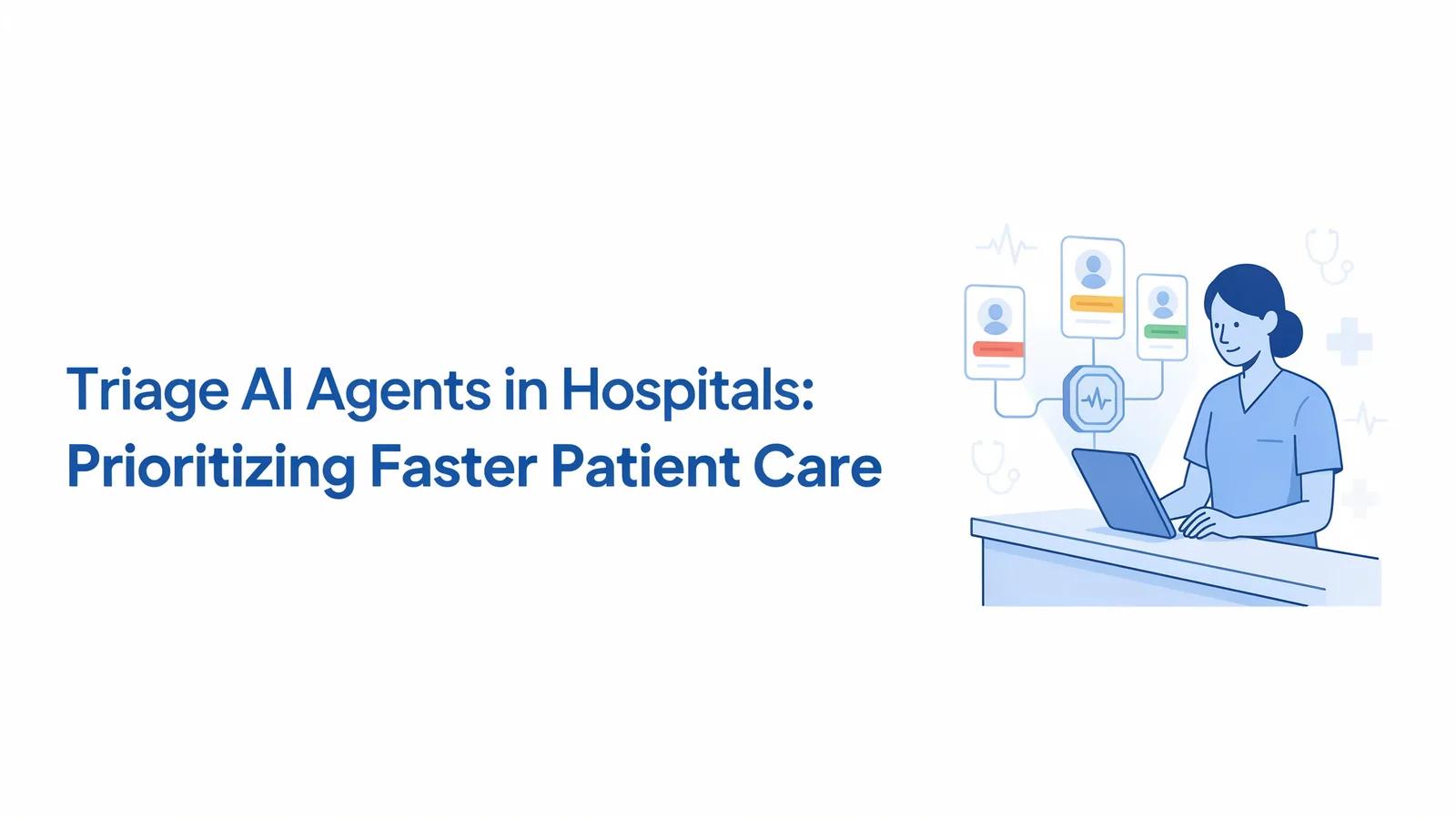
Hospital emergency departments (EDs) face an ongoing challenge: too many patients, not enough time. Delays in triage, the process of prioritizing patients based on urgency, can directly impact survival rates, patient satisfaction, and overall hospital efficiency.
This is where Triage AI Agents come in.
The machine-learning-powered triage AI agent systems are designed to assist healthcare staff in particular workflows. Rapidly assessing patients, prioritizing critical cases, and ensuring resources are allocated efficiently, are among the commonly performed tasks these systems handle with precision.
In this article, we’ll further explore how triage AI agents are transforming hospitals, the benefits they bring, their challenges to adoption, and real-world use cases. You’ll also read about examples of hospitals already seeing results, and how to obtain them with our team.
What is a Triage AI Agent?
Triage AI agents help hospitals speed up patient assessment by analyzing symptoms and medical data in real-time. They can accurately rank patients based on urgency, and recommend the next steps to clinicians, to support better quality care in decision making.
Key Functions of AI Triage Agents:
- Collect patient-reported symptoms via kiosks, mobile apps, or digital intake forms.
- Integrate with EHRs (Epic, Cerner, athenahealth, MEDITECH, eCW) for medical history.
- Use natural language processing (NLP) and retrieval-augmented generation (RAG) to interpret patient descriptions.
- Apply machine learning and fine-tuned speciality-based clinical reasoning to classify risk levels (e.g., critical, urgent, non-urgent).
- Provide clinicians with ranked patient lists, suggested protocols, and predictive treatment outcomes, with statistical insights.
Why Traditional Triage is Broken
Your traditional triage procedures carry certain limitations, since they’ve become the standardised concepts from 1980. Hence, despite having a skilled staff, your triage and patient care pain points are:
- High wait times: Patients often wait hours before being seen for a consultation. Sometimes it's also true even after driving for hours just to visit a specialist.
- Subjectivity: Human triage depends on experience and can vary in terms of accuracy and success levels.
- Resource strain: Overcrowding is a universally common factor leading to rushed assessments or ultimately inaccurate diagnoses.
- Missed risks: Subtle symptoms can get overlooked under pressure. While often they don’t complicate the treatment, missed risks are only risks in waiting, growing.
Benefits of Triage AI Agents in Hospitals
1. Faster Patient Prioritization
Triage AI agents can assess incoming patients as soon as they arrive. Thereafter, flagging those at highest risk (e.g., chest pain, stroke, sepsis) is protocol and prioritizing them to the front per their severity, is patient care made intelligent.
2. Improved Accuracy
By analyzing both structured information (vitals, lab results) and unstructured data (patient descriptions, nurse notes), AI reduces the chance of missing critical red flags and insights indicative of immediacy.
3. 24/7 Support for Staff
Unlike humans, AI agents don’t tire, or at least don’t require breaks to perform efficiently. They can continuously process intake data, freeing nurses and physicians to focus on treatment and self-care.
4. Seamless EHR Integration
AI triage systems plug into existing EHRs (Epic, Cerner, MEDITECH, etc.), so hospitals don’t need a complete IT overhaul. Connect with our team to learn how Triage AI MAS systems work for your organization and the patients.
5. Better Patient Experience
When patients feel they’re assessed fairly and quickly, too, satisfaction scores rise. AI-driven digital check-ins also reduce paperwork frustration, freeing both patients and staff from unnecessary friction(s).
Real-World Use Cases of Triage AI Agents
1. Emergency Department Triage
Hospitals use a Triage AI system to instantly classify ED arrivals, with included follow-up about recommendations, and predictive insights on optimal treatments with individualistic success rates. For example:
- Chest pain patients → Immediate cardiology consult, with the data and recommendations delivered to the specialist. The first visit with a specialist is complete with them informed about the patient history, current symptoms, and possible treatment plans.
- Minor injuries → Scheduled for standard treatment later, but not without the recommended care applied or passed on to the patient for better accessibility and care experience.
Read more: AI in Emergency Department Triage
2. Virtual Triage for Telehealth
AI agents integrated into patient portals or telehealth apps can pre-screen symptoms before virtual visits, helping doctors prepare and plan ahead.
3. Smart Scheduling
AI-driven triage can route non-urgent cases to next-day outpatient clinics, reducing ED congestion and prioritizing continuity of care in all scenarios.
4. Chronic Disease Monitoring
For repeat patients (e.g., diabetes, heart disease), AI triage agents analyze ongoing health data to flag deteriorations early. Concurrently, the triage agents also perform predictive analysis to warn patients and the healthcare specialist days before critical needs.
Case Study: How Hospitals Are Using Triage AI Today
Example 1: Mayo Clinic Platform's Perspective on AI-Assisted Sepsis Detection
Context: Rather than a single quantified pilot, Mayo Clinic Platform - Mayo Clinic's digital and AI division - has been publicly evaluating where AI adds the most value in ED triage.
What the evidence shows: Published research comparing AI-driven sepsis-detection models against standard Emergency Severity Index (ESI) screening found the AI models identified high-risk sepsis patients faster and more reliably than ESI alone. Mayo Clinic Platform's own emergency medicine leadership has said AI can meaningfully supplement, not replace, triage and clinical decision-making in the ED.
Example 2: NHS App's 2026 AI Triage Rollout (UK)
Challenge: The NHS needed a way to cut the 8 a.m. rush of patients calling GP practices for same-day appointments, and to route people to the right level of care faster.
Solution: NHS England is rolling out an AI-powered triage tool inside the NHS App, following a trial at Wealden Ridge Medical Partnership in Sussex, a practice serving 23,000 patients.
Result: The Sussex trial cut the number of patients waiting in telephone queues by 29%, with no drop in patient satisfaction. The tool is expanding to more than 200,000 patients within a year, with full national rollout targeted for April 2028, as part of a £10 billion NHS technology investment.
Example 3: Mount Sinai Health System's Admission-Prediction Study
Challenge: Across its seven New York hospitals, Mount Sinai needed a faster way to know which arriving ED patients would ultimately need an inpatient bed.
Solution: Researchers compared a machine learning model - trained on more than 1 million past ED visits - against real-time assessments from more than 500 emergency nurses, across nearly 50,000 patient visits over two months.
Result: The model matched or outperformed nurse-based predictions and flagged likely admissions hours earlier than standard workflows allow, giving staff more lead time to arrange beds and specialists. Mount Sinai is now testing the model in live workflows to measure its effect on boarding and throughput.
Example 4: Peer-Reviewed Evidence Across Three Emergency Departments
Challenge: Most triage AI claims come from vendor case studies or single-hospital pilots, which makes it hard for hospital leadership to separate marketing from clinical evidence.
Solution: A multisite quality improvement study published in NEJM AI evaluated an AI-informed triage clinical decision support tool across three emergency departments, comparing 83,404 patient visits before the tool went live with 91,244 visits after it did - 174,648 visits in total.
Result: Correct identification of patients needing critical care (ESI level 1 or 2) rose from 78.8% to 83.1%, and median time from arrival to an initial care area dropped 33%, from 12 minutes to 8. Rates of hospitalization, ICU admission, and in-hospital death held steady — evidence, the study's authors note, that the tool re-sorted patients into more accurate acuity levels without changing who actually needed intensive care.
Lessons Learned from These Hospitals
- Integration is key: Hospitals succeeded when AI was embedded into existing EHR workflows, not added as a standalone tool.
- Transparency builds trust: Clinicians were more likely to adopt AI when its risk-ranking logic was clear and explainable.
- Patient satisfaction rises: Digital check-ins gave patients confidence that their cases were being assessed quickly and fairly.
Interested to see how AI triage agents can optimize the patient care workflows of your hospital(s)?
At Ciphernutz, we specialize in building custom AI-powered healthcare solutions that align with your immediate objectives, compliance needs and patient care goals.
Challenges of Implementing AI Triage Systems
1. Data Privacy & Compliance
Hospitals must ensure HIPAA compliance and data security when handling sensitive patient records. Since triage AI agents deal with protected health information (PHI), robust encryption, secure APIs, and strict access controls are critical.
Since non-compliance can lead to legal consequences, loss of patient trust, and reputational risks - ensurinig regulatory alignment from day one is paramount. Partner with an experienced AI agent development company to become compliance-ready.
2. Trust & Adoption
Clinicians may hesitate to rely on AI without transparency into its decision-making process. Explainable AI (XAI) becomes essential in healthcare, allowing providers to understand why a triage agent flagged a case as urgent.
In times like today when patient frustration and staff burnouts are rising, hospitals should focus on building trust by offering clear audit trails, clinician oversight, and gradual adoption models. Here, AI acts as a decision-support tool rather than a replacement for the essentials (your staff) who bring and add value in patient care.
3. Integration Costs
While AI agents integrate with EHR/EMR systems, initial setup, data mapping, and staff training will require certain investment. Beyond implementation, ongoing maintenance and system updates must also be budgeted irrevocably. However, long-term savings collectively - through reduced wait times, optimized resource allocation, and improved outcomes - often outweigh the upfront costs.
4. Ethical Concerns
AI must avoid bias and bias-led decisions, especially when dealing with diverse patient populations. Biased training datasets can lead to unequal treatment or misdiagnosis, or unknown inconsistencies. Hospitals should absolutely ensure their AI solutions are trained on inclusive datasets that represent gender, age, ethnicity, and comorbidity diversity. Regular auditing of algorithms additionally helps maintain fairness and equity in patient care.
5. Interoperability Challenges
Hospitals often use a mix of legacy systems, modern EHRs, and third-party applications. Ensuring that AI triage agents can seamlessly exchange data across platforms is a major challenge. Otherwise, without interoperability, AI solutions risk creating silos instead of solving workflow bottlenecks. Still, leveraging industry standards like FHIR (Fast Healthcare Interoperability Resources) helps minimize these issues.
Future of Triage AI in Hospitals
The next phase of hospital automation lies in multi-agent AI systems (MAS), where different AI agents collaborate to manage specialized roles throughout the triage and care journey. Instead of relying on a single system to perform all the tasks across healthcare levels, hospitals will deploy custom networks of specialized agents working in harmony:
- Intake Agent: Handles initial patient registration, symptom reporting, and medical history collection using conversational AI and secure integrations with hospital databases.
- Symptom Risk Analysis Agent: Uses reasoning AI and medical knowledge graphs to evaluate reported symptoms, assess severity, and flag high-risk patients for immediate intervention.
- Routing & Scheduling Agent: Automatically directs patients to the right care pathway (emergency physician, specialist, or outpatient clinic) while updating hospital schedules in real time.
- Documentation Agent (Future Role): Captures ambient clinical notes, transcribes doctor-patient conversations, and syncs them to EHR systems with minimal human input.
- Follow-Up Care Agent (Future Role): Manages outpatient engagement by tracking recovery progress, sending reminders, and escalating issues to clinicians when necessary.
Together, these collaborative triage AI agents will create a smarter, adaptive, and resilient triage system, capable of handling dynamic patient volumes, healthcare conditions, while reducing bottlenecks and being accurate.
Triage AI Agents for Hospitals in 2026: Adoption Data and What's Changed
By 2026, triage AI agents for hospitals have moved from pilot programs into daily operations at a growing number of health systems, and three shifts stand out.
Adoption is broader than the triage use case alone. Federal data tracked by the Office of the National Coordinator for Health IT found that 71% of U.S. hospitals had at least one predictive AI tool built into their EHR by 2024, up from 66% the year before — and triage sits at the front edge of that shift, since it's the first automated decision every incoming patient touches.
The evidence base has also caught up with the marketing. Beyond the peer-reviewed study above, system-wide rollouts are producing real numbers too: the NHS App's 2026 national expansion followed a trial at Wealden Ridge Medical Partnership in Sussex, England, that cut patients' phone queue waits by 29%, with no drop in reported satisfaction.
Clinician trust remains the deciding factor. A January 2026 study in *Frontiers in Digital Health* found emergency medicine professionals stay noticeably more cautious about AI-supported triage than administrators or technologists — which is exactly why explainable, override-friendly systems, not fully autonomous ones, are what's actually getting deployed in EDs today.
For a closer, step-by-step look at how a triage AI agent actually processes a patient's reported symptoms, read our blog What is a Triage AI Agent and How Do They Work?
If you're weighing where triage AI fits into a broader automation roadmap - EHR integration, HIPAA-compliant infrastructure, patient engagement - our healthcare automation team can map out what that build looks like for your hospital.
Conclusion: Prioritizing Faster Patient Care with AI
Triage AI agents are presently indispensable, they’re already a present-day necessity for hospitals aiming to improve patient flow, reduce delays, and deliver faster, safer care. By integrating these agents, healthcare organizations can transform triage into a patient-first, data-driven process that saves lives and optimizes operations.
Partnering with the right AI agent development company ensures seamless implementations, compliance, and planned scalability, helping hospitals evolve with the innovations of global healthcare technology.
FAQs on Triage AI Agents
1. How does an AI triage system work in hospitals?
AI triage systems collect patient data, analyze symptoms, and assign priority levels using algorithms. They then guide clinicians on who should be treated first by additionally delivering recommendations and predictive outcomes.
2. Can AI replace human triage nurses?
No, and they are not designed to replace human healthcare staff. AI agents assist the humans by acting as decision-support tools, giving the staff more accurate data to make informed final calls.
3. Are AI triage systems HIPAA compliant?
Yes - if implemented correctly. Vendors design these triage AI systems with encryption, audit trails, and strict data handling to meet HIPAA and GDPR standards.
4. What are the main benefits of AI triage agents?
- Reduced wait times
- More accurate prioritization
- Less clinician burnout
- Improved continuity of care
- Better patient satisfaction
5. What challenges do hospitals face in adopting triage AI?
Key challenges include data privacy, trust among clinicians, integration costs, and avoiding algorithmic bias.
6. Where are triage AI agents already being used?
Hospitals in the US, UK, and Europe are piloting AI triage tools in emergency departments, telehealth portals, and outpatient clinics.
7. Will AI triage reduce ER overcrowding?
Yes. By routing non-urgent cases to clinics or virtual care, AI triage helps free up emergency departments for critical patients.
8. What results are hospitals seeing from AI triage agents in 2026?
Recent data backs up the promise: a peer-reviewed multi-site study found AI-assisted triage improved correct identification of critical care patients from 78.8% to 83.1% and cut time-to-care by a third, while NHS-backed rollouts have cut patient queue waits by nearly 30% in early trials.
Results vary by hospital and implementation, but the direction across published 2026 data is consistent - faster identification of high-risk patients and shorter waits for everyone else.