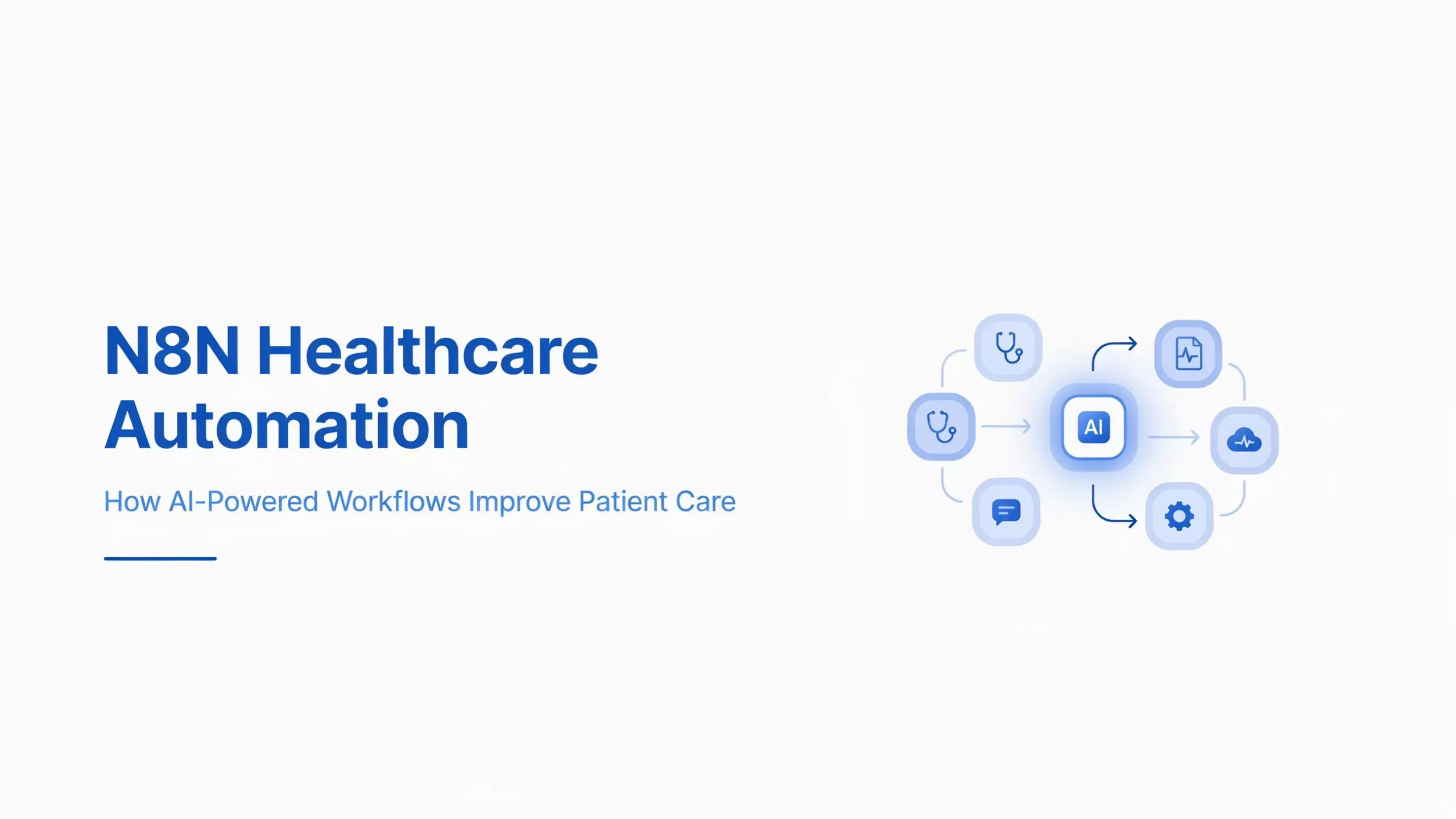
In healthcare, patient data like lab results, vitals, and medical history are equally crucial as time and money. While its analysis typically helps to offer clarity, maintaining its accuracy is a paramount need.
Hence, there are standards like HL7, FHIR, and tools like n8n, that can modernize the hospital workflows while operating faultlessly.
These digital health platforms can automate entire clinical workflows with traceability, compliance, and scalability.
Thus, this blog will explain how n8n healthcare automation works and how to set it up for FHIR-based clinical workflows. You'll also learn about how to deploy production-grade integrations that are secure and modular.
Key Takeaways
- n8n automates healthcare workflows without expensive enterprise integration platforms.
- Supports HL7 and FHIR interoperability.
- Connects EHRs, LIS, CRMs, billing systems, and patient communication platforms.
- Reduces administrative workload and clinician burnout.
- Works with AI Agents for intelligent clinical automation.
- Enables secure, scalable, HIPAA-ready workflow orchestration.
What Is N8N?
n8n is short for nodemation, an extendable workflow automation tool that enables seamless integration between systems via visual and node-based logic. For healthcare, n8n unlocks interoperability across EHRs, lab systems, patient portals, and billing tools.
According to industry reports, over 80% of healthcare organizations are investing in automation to improve efficiency, making low-code tools like n8n a critical asset in digital transformation
Why Does Healthcare Need n8n Automation?
The healthcare providers today have multiple challenges that can affect the efficiency, quality and safety of patient care. Yet still, an automation with n8n addresses all of these challenges head-on by simplifying complex workflows, reducing manual efforts, and enhancing system integration.
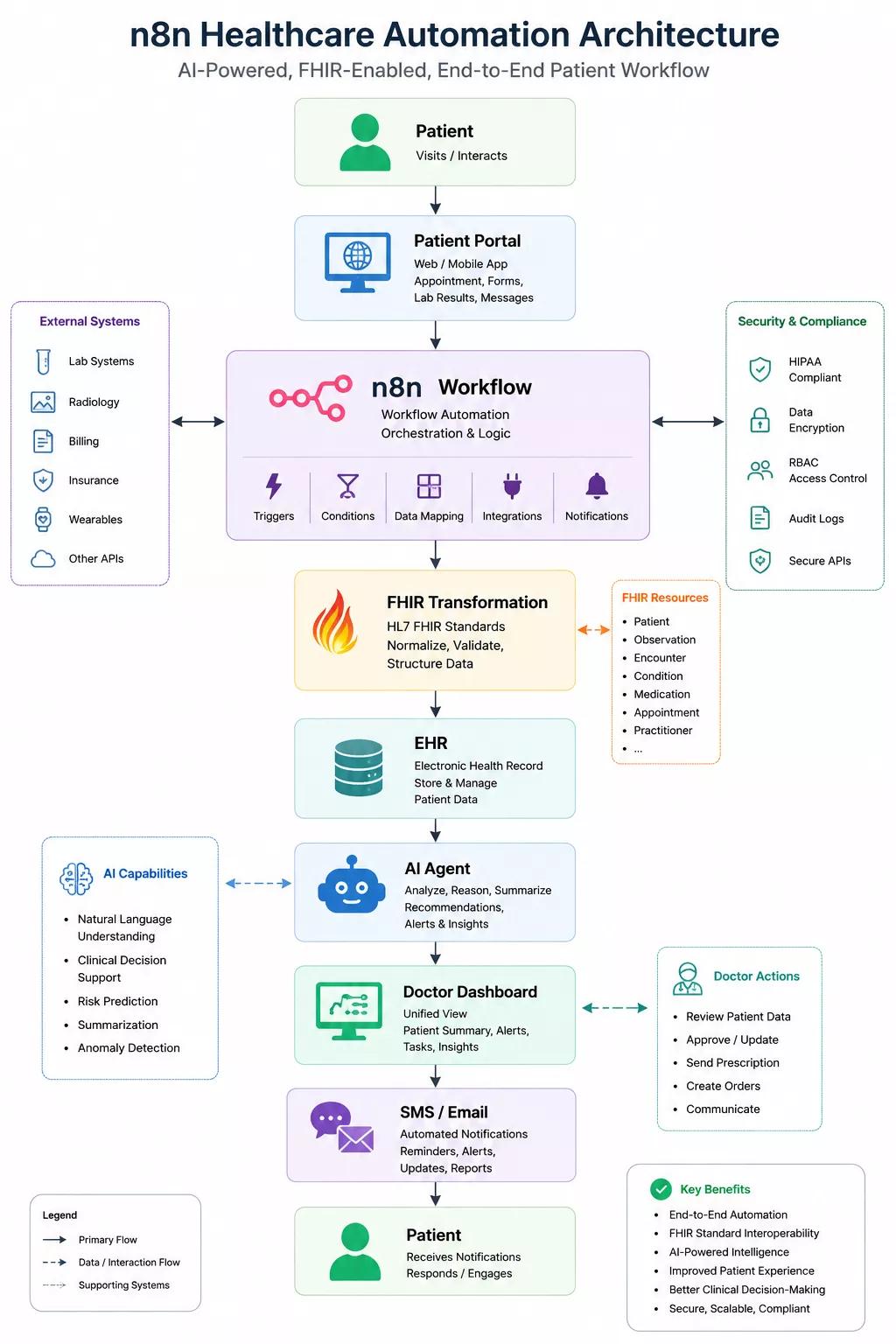
Here are additional reasons why healthcare needs n8n workflow automation.
1. EHR Fragmentation - #1 Healthcare Pain Point
Electronic Health Records (EHR) systems often pose difficulties in sharing patient data seamlessly across the healthcare department and to the providers. Operating as if in a silo, this fragmentation causes effort duplication, further delaying care and increasing data error possibilities.
Here, the n8n can adhere to multiple healthcare standards, including HL7 and FHIR, enabling smoother and regular automated data exchange between disparate EHR systems.
You can directly skip costly custom development by arranging pre-built connectors and low-code workflow orchestration to unify patient data. A cohesive experience is then yours to offer without surplus infrastructure additions.
Read more: How to Integrate N8N with EHR System
2. Staff Burnout - #2 Healthcare Pain Point
Overwhelming tasks like clinical data entry, appointment management, and manual modifications are leading causes of healthcare staff burnout. Such overhead also reduces the collective staff efficiency, effectively reducing patient care quality at once, if not constantly.
Contrarily, with an n8n automation in healthcare, the routine tasks are automated so patient-facing activities can be prioritized with better focus.
Moreover, reduction in manual work also lowers rate of errors and makes patient-data communication streamlined between the teams.
3. Manual Follow-ups - #3 Healthcare Pain Point
The delivery of timely follow-ups, test results and appointment reminders are necessary for developing positive health outcomes, but they are prone to delays and missed communication.
Using n8n, healthcare organizations can automate patient notifications across multiple channels like email, SMS, or phone calls.
Workflows, too, can be customized by applying conditional logic to prioritize urgent cases, track responses, and trigger escalations as required.
4. Compliance Bottlenecks - #4 Healthcare Pain Point
Healthcare providers must comply with strict industry regulations namely HIPAA and GDPR, which requires top-notch sensitive data handling and auditing capabilities. Inflexible systems in such scenarios can create bottlenecks and risk non-compliance.
But, with n8n supported self-hosting, your healthcare organization can have full control over the data environment, whose workflows will securely transfer the data without manual interventions.
You also get encrypted communications and audit trails to meet compliance needs without slowing down your operations or switching their flow.
Read more: How N8N Transformed Healthcare Data Handling
5. Inefficient Patient Journeys - #5 Healthcare Pain Point
Patients aren't new to encountering fragmented, slow, and confusing care journeys caused by disconnected systems and manual processes. This ultimately impacts their satisfaction and the care outcomes.
The n8n can solve this by enabling seamless integration across systems responsible for scheduling, clinical records syncing and communication systems. Automating data sharing and real-time updates delivery contributes to creating efficient, patient-centered workflows that improve engagement and care pathways.
Advantages of Using n8n in Healthcare Automation
1. Flexibility without Vendor Lock-In
Unlike Zapier or Make, n8n is open-source and self-hostable. You retain full control over data and logic with n8n, offering a critical advantage in a domain as sensitive as healthcare.
2. Cost-Effective Digital Transformation
Large-scale integrations can cost millions. whereas the n8n significantly reduces development and operational costs by enabling low-code automation at scale.
3. Enhance EHR Interoperability
Most EHRs are rigid in terms of their operability between connected systems, but n8n isn't. In hospitals, IT teams can build adaptive workflows that transform and route data using FHIR, HL7, or even custom APIs - all without altering the core EHR system.
4. High Adaptability
Whether the workflow demands scheduling, diagnostics, pharmacy management, or billing, n8n can bridge systems and automate end-to-end processes without requiring to begin from square one.
| Platform | Healthcare Ready | Self Hosted | AI Integration |
|---|---|---|---|
| n8n | Yes | Yes | Excellent |
| Zapier | Limited | No | Basic |
| Make | Moderate | No | Moderate |
| MuleSoft | Enterprise | Yes | Excellent |
Real Use Cases of n8n Healthcare Automation: How Does it Work?
n8n in healthcare automation helps hospitals, clinics, and care providers to orchestrate multi-system workflows with precision and efficiency. The use cases given below detail where n8n in hospitals is actively reducing workflow latency, eliminating time-consuming manual steps, and improving clinical decisions.
1. Lab Report Automation
Laboratories rely on manual or semi-automated steps to upload test results into EHR systems. With n8n healthcare workflow automation, a connected lab information system (LIS) can trigger the workflow process whenever a new result is generated.
n8n fetches the report, formats it into a structured form i.e. JSON, CSV, etc. and then maps critical values against the clinical thresholds. For any anomalies that may be found, a decision node triggers a secure message to the responsible physician through platforms like slack, or email.
This report can also be converted into a FHIR Diagnostic Report resource to be automatically pushed to the patient's EHIR, making the results instantly accessible, increasing care delivery speed. Such outcomes are impactful and achievable particularly when working with a custom healthcare software development company to retain data security & standardization.
Read more: n8n for Medical Lab Automation
2. Appointment and Scheduling Workflows
Fragmented tools like calendars, CRM systems, and manual confirmations make appointment scheduling delayed. n8n simplifies it with time-based or event-driven triggers and workflows that integrate popular systems like google calendar, calendly, EHR appointment modules, and SMS gateways.
Take for instance, when a patient confirms booking a consultation, n8n updates the clinician's calendar after cross-checking for overlaps. Then, it sends the patient a confirmation message, and logs all these events in the EHR. If at all a reschedule is requested. The same workflow can be re-triggered and looped with updated logic as required.
Establishing such automation, when paired with AI agents (built via AI agent development services) can even assist in auto-rescheduling appointments or keeping follow-up workflows using NLP intent detection.
3. Insurance Pre-Authorization & Billing
Getting insurance approval is one of the biggest bottlenecks that are responsible for treatment delays. Using n8n, hospitals can solve the bottleneck by connecting to payer APIs for building pre-authorization workflows. A typical sequence will include submitting patient diagnosis codes, checking coverage eligibility, receiving status updates, and updating the billing dashboard.
These automations can eliminate repeated data entry across the claim forms and EHRs. For startup health tech platforms, this is among the common MVP features. If you want to build one too and rapidly, the MVP development services in the USA can be approached as they specialize in healthcare workflows.
A further integration of n8n with FHIR resources like coverage or claim, makes the workflow more interoperable by making them ready for scalability across payers and systems.
4. Post-Discharge Patient Follow-Up
Everything related to post-discharge or post-care management is usually disconnected from hospital workflows. n8n functions to make it inclusive by monitoring discharge records and initiating automated outreach sequences.
For example, after a discharge summary is logged, n8n can trigger a 3-day follow-up SMS survey, sync any responses to the care team dashboard, and escalate any alerts to care teams.
Advanced flows for patient post-care with n8n includes integration of wearables, where patient vitals are monitored post-discharge. Upon reading critical changes, triggers can be set to alert or schedule a virtual consultation.
It's possible to further extend this automation by working with teams or when you hire AI agent developers with proper domain knowledge in telehealth.
Why is n8n + FHIR a Powerful Combo for Healthcare Automation?
The FHIR (Fast Healthcare Interoperability Resources) is the standard protocol used for modern healthcare data exchange. While most EHRs now support FHIR, their APIs can still be complex and brittle in use, where n8n acts as the orchestrator to simplify the connected integrations.
The n8n's HTTP and JSON functions can be utilized as follows:
- Pull structured patient data from third-party tools
- Transform the structured data into FHIR-compliant formats like Observation, Patient, Procedure, etc.
- Push the transformed data to certified EHR systems using RESTful FHIR APIs.
Such modular workflow management using n8n in healthcare is also possible to set up with a small IT team to drive complete interoperability without needing an integration engine separately. The latter is often ideal for hospitals who work with IT consulting companies or want to explore in-house automation without burning resources excessively.
How To Build N8N Tactical Implementation for Hospitals?
Tactical implementation of n8n for hospitals mainly involves setting up the FHIR API Workflow Integration with n8n. You can achieve this in multiple ways but the following options are preferred by the industry experts.
Start with MVP-Style Automation
Instead of building a system-wide automation, begin with a Minimum Viable Process:
- Evaluate & choose 1-2 critical workflows (lab syncing, appointment updates, etc.)
- Create simple workflows using n8n healthcare workflow automation
- Monitor outputs, identify inefficiencies, and iterate improvements as needed
Hire the Right Team
For effectively implementing n8n in regulated environments, its essential to hire n8n experts or hire dedicated software development teams with experience in:
- HL7/FHIR interoperability
- Healthcare automation pipelines
- Role-based access and audit trails
Working with a custom healthcare software development team in the USA and India can offer better insights into both processes and its deliverables.
Future Scope: AI Agents + n8n in Healthcare
Move beyond rule-based tasks to enable intelligent, context-aware decisions and automate post-discharge monitoring, real-time alerts, or EHR data orchestration with n8n + AI agent integration.
The AI agent healthcare integration with n8n is among the leading uses of AI agents & n8n in healthcare followed by agentic reasoning AI doctor. Together, they can unlock greater clinical & operational utility and preliminary diagnostics and triaging, respectively.
For example, rather than a simple “if-else” rule to escalate abnormal vitals, an AI agent can perform reasoning based on context - reviewing medication history, diagnosis codes, and even behavioral signals.
If you want to achieve all of the above faster, partner with teams that specialize in custom healthcare software development or AI agent development services. Connect with MVP healthcare automation pilots today.
Frequently Asked Questions
What is n8n used for in healthcare?
Automating EHR syncing, appointment reminders, patient communications, and AI triage.
Is n8n HIPAA compliant?
n8n itself is not certified but can be self-hosted in a HIPAA-compliant environment.
Can I use n8n to integrate with my hospital's EHR?
Yes, if the EHR supports APIs, HL7, or FHIR standards, you can integrate it using n8n's HTTP and webhook nodes.
How does modular architecture in n8n help with healthcare workflows?
n8n's modular node structure enables decoupled, testable automation components. Each node handles a specific task like fetching data, transforming it, or triggering actions. This setup simplifies debugging, reuse, and compliance audits.
Can AI agents be integrated into n8n healthcare automation?
Yes. Using webhook, Python, or OpenAI nodes, n8n can integrate AI agents for tasks like summarizing patient notes, triaging inputs, or scheduling based on NLP. Contact teams offering AI agent development services if you want assistance in building such flows.
How do you ensure token-level security in n8n workflows?
Use encrypted environment variables for API keys, OAuth for user access tokens, and role-based access control. Hosting behind firewalls and using logging for audit trails also secures token interactions.
Why should a hospital consider MVP-style automation first?
MVP automations reduce risk and support faster outcome validation. For hospitals, this means immediate adoption, quicker feedback, and clearer cost-benefit mapping.